

A good sample proves one thing: the supplier can make one good batch.
It says nothing about whether your fourth reorder will match it, whether your barcode lands on the right carton, or whether your best-selling model will still exist next year. Those are the failures that cost a distributor money. One mislabelled pallet and you’re paying for freight, replacement stock and a difficult call with a contractor who trusted your brand.
This checklist is for regional distributors, importers and wholesalers vetting a manhole step supplier for repeat business. Every item comes with the evidence you should ask to see, because a confident answer on a video call isn’t evidence. If you’re choosing a factory for a single large project instead, our guide on how to choose a manhole step manufacturer for bulk projects is the better starting point.
Here’s the whole checklist on one page. Each row is covered in detail below.
| Audit area | What to confirm | Evidence to ask for |
| Company and supply role | Legal entity, who manufactures, what’s outsourced | Company documents, process flow for your models |
| Model coverage | SKUs, sizes, materials, substitution rules | Product catalogue, dimensioned drawings |
| Technical quality | Materials, test evidence, critical dimensions | Model-specific test reports, inspection records |
| Packaging and labels | Carton spec, barcodes, brand and label versions | Approved packaging sample, label artwork files |
| Repeat-order consistency | Batch ID, sampling, nonconforming product | Batch records, corrective action reports |
| Change management | Drawing revisions, spec and label changes | Written revision-control procedure |
| Delivery | MOQ, lead times, replenishment, partial shipments | Written delivery plan |
| Commercial responsibility | Claims, rework, replacement stock | Contract terms, quality agreement |
Verify the Supplier’s Business and Manufacturing Role
Before anything else, find out who makes the steps, who inspects them, and who carries the responsibility when a batch fails. A trader can be a perfectly good partner. A supplier that’s vague about which parts of the process it controls is not.
Confirm the Registered Business and Actual Supply Chain
Start with the legal entity that will sign your contract and appear on the export documents. Then put the question plainly: are you the manufacturer, a trading company, or a coordinator working with several factories? For a closer look at those roles, read manufacturer vs trader for manhole steps.
None of those answers is disqualifying. A hidden answer is. If any step is done elsewhere, say galvanizing or coating, you need to know which one, who inspects the parts when they come back, and whose name is on the quality responsibility if they fail in a chamber two years from now.
Review Production and Supply Capabilities
Skip the factory tour video. Ask for the process flow for the specific models you plan to buy: where the core is formed, where the anchoring end is made, where coating or plating happens, and where final inspection and packing take place.
Then ask which of your models they already supply as standard and which they’d be making for the first time. The second list is where your risk sits. Know how long it is before you put those models in your catalogue.
Audit Product Range and Model Coverage
You sell a range, not a part. Get the supplier’s full model list in writing and sort every item into standard, modified or new-tooling before you build your catalogue around them.
Request a Complete Product Model List
For each model, the list should give the product code, dimensions, core material and diameter, protective finish, colour and intended application, such as sewer, stormwater or telecom chambers. A brochure with photos and no dimensions isn’t a model list.
While you have it open, map their codes to your SKUs in a simple cross-reference sheet. It’s a dull afternoon’s work, and it catches code mix-ups before they ever reach a carton.
Check Standard Products Against Custom Options
“Custom” covers a wide range of effort, and the price and timeline follow the effort:
| Type | What it means | What usually changes |
| Standard | Existing model, existing tooling | Lowest MOQ, no new sample |
| Modified spec | Existing model with a different width, colour, leg length or marking | New drawing approval, often a new sample |
| New tooling | New geometry or anchoring end | Tooling cost, longer sampling, higher MOQ |
For practical MOQ and delivery questions by order type, see our manhole step lead time guide.
Ask the supplier to put MOQ, sample requirements and lead time against each bucket. As a benchmark for the level of detail to expect, FERR’s custom manhole steps list exactly which variables can change: step width, wall projection, tread profile, leg length, embedment depth and anchoring-end geometry, in polymer-encapsulated or hot-dip galvanized versions.
Confirm SKU Availability and Substitution Rules
Ask what happens when a model is discontinued. How much notice do you get? Will the replacement need a new drawing approval and sample before it ships to you?
Get the answer in writing. “We’ll send an equivalent” is how a distributor ends up with steps 10 mm wider than the contractor specified.
Verify Product Quality and Technical Compliance
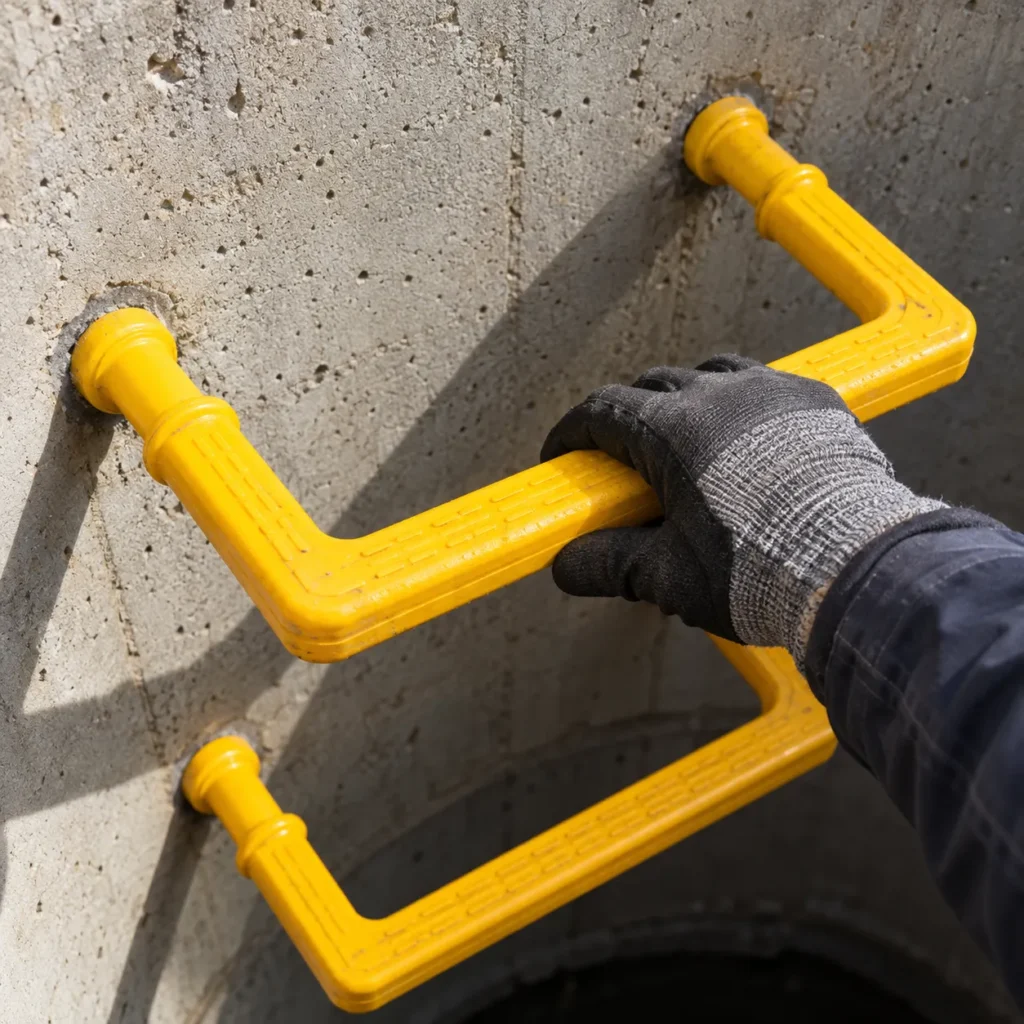
Test reports and certificates only count if they cover the exact model, material and finish you’re ordering. A generic “manhole steps” report tells you very little about yours.
Match Test Reports to the Exact Product Model
On every report, check the model or drawing number, material, test method, test date, who did the testing and what the scope covers. A report on a different width or core diameter doesn’t carry over. Neither does one dated before the supplier changed its steel or coating source, so ask whether anything has changed since the report was issued.
Check Critical Dimensions and Material Specifications
These decide whether a step installs properly and stays put:
- Core material and diameter
- Step width and tread profile
- Anchoring end: leg length, embedment depth and end geometry
- Wall projection once installed
- For PP-encapsulated steps, full coverage with no exposed steel, especially at the leg ends
- For galvanized steps, zinc coating thickness and coverage
- The tolerances on the approved drawing, not just the nominal sizes
For each one, ask how it’s measured, with what, and how often. For the full factory-selection process, see how to choose a manhole step manufacturer.
Review Batch Inspection and Traceability Records
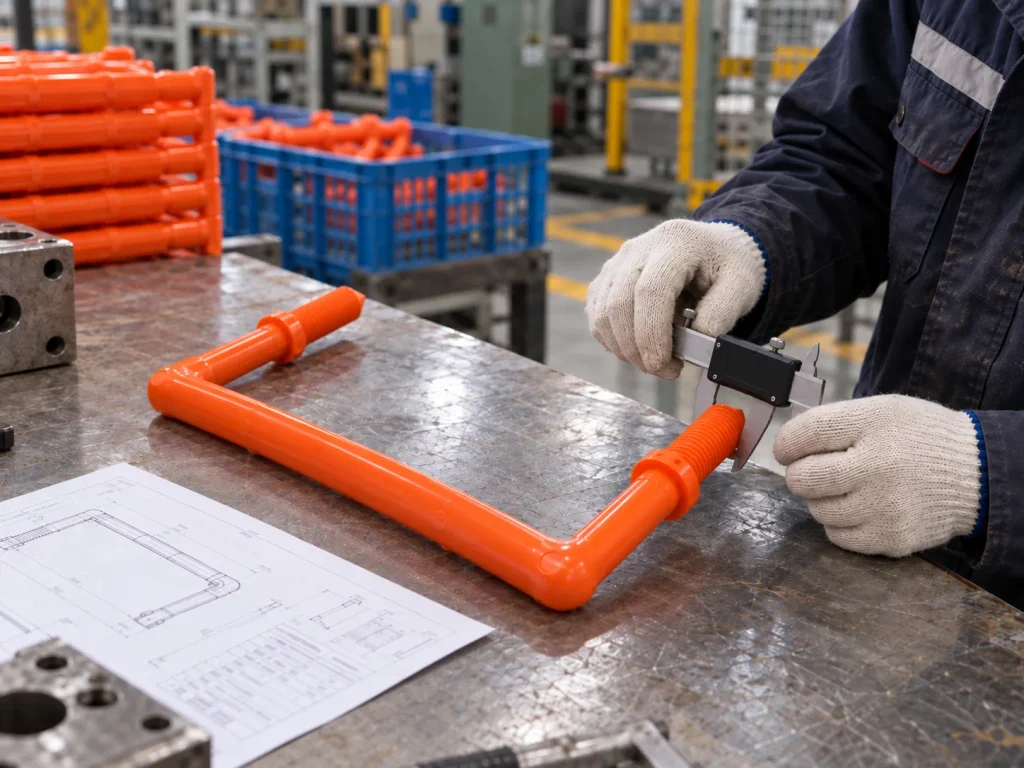
Ask how they handle incoming material checks, first-article approval, in-process inspection, final sampling and nonconforming parts. Then ask to see a completed record from a real past batch, with the customer’s name blacked out if needed. A blank form proves they have a template. A filled-in one proves they use it. Use our manhole step sample qualification guide to plan first-article acceptance.
Verify Applicable Standards and Project Requirements
In Europe, the product standard is EN 13101, Steps for underground man entry chambers. It covers requirements, marking, testing and evaluation of conformity. Other markets and many projects set their own requirements, so confirm what applies to your sales first, then ask for evidence against that.
Keep two kinds of paper apart. An ISO 9001 certificate shows the supplier runs a quality management system. It doesn’t prove that a particular step meets a particular standard.
Audit Packaging, Private Labels, and Shipping Marks
General factory audits often skip this, yet it’s the first thing your warehouse and your customers notice. Lock down packaging, labels and barcodes before mass production, not after the first container arrives.
Confirm Packaging Specifications
Agree on pieces per carton, how each step is protected, carton size and gross weight, pallet type and stacking, and any packaging rules in your market. If wooden pallets are involved, they’ll need to meet ISPM 15, the international standard for wood packaging in trade.
Inner protection matters more than it looks. Coated steps rubbing together for weeks at sea can arrive scuffed through, which defeats the point of paying for the coating.
Verify Private Label and Barcode Capabilities
List everything that carries your brand or data: product label, carton label, barcode, your SKU code, language, logo and label position. If you use retail-style barcodes, the numbers should come from your own GS1 allocation. The supplier prints them; it shouldn’t make them up.
Then ask two questions:
- Can each SKU carry its own label version?
- How do you stop two similar-looking models from getting each other’s labels?
The second answer tells you most of what you need. Separate packing runs and a label check against the order are good signs. “Our workers are very careful” means you’ll be the one catching the mistakes.
Approve a Packaging Sample Before Mass Production
Sign off a physical packaging sample covering the carton, inner protection, labels and shipping marks. Give your label artwork a version number and have the supplier quote that number on the order. Keep the approved sample, or dated photos at minimum, so every later shipment has something concrete to be checked against.
Evaluate Repeat-Order Consistency
Reorders stay consistent because of records and controls, not because a sales rep promised they would. What you’re checking is whether each reorder is tied back to the approved sample and drawing.
Compare Production Batches with the Approved Sample
Does the factory keep a retained sample of what you approved? Does every reorder reference the same drawing revision? If either answer is no, each reorder is really a new first order.
Keep a retained sample on your side too. When a delivery lands, measure a handful of steps against it and the drawing. Ten minutes per shipment is cheap compared with a rejected pallet.
Check Batch Records and Quality Deviations
Find out how a batch is identified (on the step, the carton or both), how deviations are recorded, and where nonconforming parts are kept so they can’t be packed by accident. The goal is a traceable line from a customer complaint back to one batch.
Confirm Repeat-Order Planning and Product Availability
For your regular models, ask how production is scheduled, where the core and coating materials come from, and how you’ll hear about lead-time changes. Two weeks’ warning of a delay is manageable. Finding out on the shipping date isn’t.
Ask How Quality Problems Are Corrected
Ask for a real example: a dimensional deviation, a coating defect or a packing error, and what they did about it. You’re looking for a root cause, containment of affected stock, and a change that stops it recurring. A supplier who claims they’ve never had a complaint usually just hasn’t written one down.
Settle who pays before anything goes wrong. Replacement parts, freight and any rework at your end should be covered in a quality agreement, not negotiated mid-dispute.
Check Drawing Revision and Order Change Management
Every order should point to one approved drawing revision, and every change to material, dimensions, labels or packaging should be approved in writing. Without that, old specs have a way of quietly coming back.
Confirm the Approved Drawing Revision
Each drawing needs a revision number, date and approval status, and your purchase order should cite that revision. If the shop floor works from “the latest one in the email thread,” a mistake is only a matter of time.
Understand What Happens When Specifications Change
Agree upfront on what triggers a new quote, a new sample or a new delivery date. A colour change may need none of them. A change to leg length or core diameter will almost certainly need all three.
Check How Changes Are Communicated Across Teams
Production, QC, packing and export documentation all need to work from the same approved file. Ask how superseded drawings and old label files are pulled out of use. A lot of repeat-order errors start right here: one team got the update and another didn’t.
Review MOQ, Lead Times, and Replenishment Capacity
For a distributor, real capacity shows up in mixed-SKU orders and urgent top-ups, not in one big production run. Get lead times broken down by stage, and get delivery commitments in writing.
This section is about whether a supplier can keep you stocked. To compare prices across suppliers, see Bulk Manhole Steps: How to Compare Quotes Fairly.
Separate Standard and Custom Product Lead Times
Ask for each stage as its own line: existing models, modified specs, tooling, sample approval and mass production. A single “30–45 days” figure hides which stage is the usual bottleneck.
Confirm Capacity for Repeat and Mixed-SKU Orders
Not every distributor orders by the container. If you buy a dozen models in modest quantities, check whether MOQ applies per SKU or per order, because that one detail decides whether the supplier fits your business. Then ask whether different models can share a production run, whether partial shipments are accepted, and how an urgent top-up of one fast-moving SKU is handled.
Define Delivery Commitments in Writing
Pin down when the lead time starts (deposit, drawing approval or sample approval), when packing is complete, how partial shipments work and how much notice you get of a delay. The start date alone can shift your real delivery by weeks.

Score the Supplier Before Approving a Long-Term Partnership
Use a weighted score to compare suppliers, but treat technical compliance, required test evidence and contract responsibility as pass/fail. A high score elsewhere should never buy back a failed requirement.
Use a Practical Supplier Audit Scorecard
These weights are a suggested starting point, not an industry standard. Shift them to match what hurts your business most.
| Category | Weight |
| Model coverage and technical match | 20% |
| Product quality and technical evidence | 25% |
| Packaging and labelling | 15% |
| Repeat-order consistency and traceability | 20% |
| Change management | 10% |
| Delivery and communication reliability | 10% |
Score each category from 1 to 5 based on evidence you’ve seen, not answers you’ve heard. Multiply by the weight and add up, and you get a total out of 5 that’s easy to compare across suppliers.
Separate Mandatory Requirements from Scored Items
Meeting the product’s technical requirements, having the test evidence your market requires, and accepting clear contractual responsibility for defects are entry conditions. A supplier that fails one is out, however well it scores. Great packaging doesn’t rescue a step that’s out of spec.
Start with a Controlled Trial Order
Size the first order to your real demand, not the supplier’s preferred quantity. Use it to check the product against the drawing, the packaging against the approved sample, the documents against the order and the delivery date against the promise. A pre-shipment inspection, by your own team or a third party, catches problems while they’re still the supplier’s to fix. Scale up only after that order passes.
Request a Long-Term Supply Review from FERR
Planning repeat manhole step orders? We can review your requirements and talk through supply options. FERR makes custom manhole steps in polymer-encapsulated and hot-dip galvanized versions, with custom colours, markings and packaging. Final requirements are confirmed in an approved drawing, and sample or first-article approval can be included before batch release.
Send us your required models, estimated annual volume, packaging and labelling specs, and target delivery market. Not sure what to include? Our manhole steps RFQ checklist covers the 12 details that make a quote accurate the first time.
Request a Bulk Supply Quotation
FAQ
What should distributors check when auditing a manhole step supplier?
Start with the things that are expensive to fix later: who actually manufactures the steps, whether test evidence matches your exact models, whether the supplier can apply your labels correctly, and how reorders are kept consistent. Then check drawing revision control, lead times by stage, and who pays when something goes wrong. Anything the supplier can’t document should count as a risk.
How can distributors verify manhole step quality across production batches?
Ask for batch identification on the product or carton, a retained approved sample at the factory, and completed inspection records from past batches. On your side, keep your own retained sample, measure a few steps from every delivery against it and the drawing, and log the results. A log across several orders shows slow drift that one spot check would miss.
What packaging and labeling information should a manhole step supplier provide?
Expect pieces per carton, inner protection method, carton dimensions and weight, pallet specification and shipping mark layout. For private label orders, you also need label artwork with version numbers, the barcode format and data source, label positions, and the supplier’s method for keeping labels for similar models apart. Approve a physical packaging sample before mass production.
How should suppliers manage drawing revisions and product changes?
Each drawing should carry a revision number, date and approval status, and each purchase order should name the revision it follows. Changes to material, dimensions, colour, labels or packaging should be approved in writing, with any effect on price, sampling or lead time stated. Superseded drawings and label files should be removed from production, QC and packing.
What documents should distributors request before approving a bulk order?
At minimum: company registration documents, the approved drawing with its revision number, model-specific test reports where your market requires them, a sample or first-article approval record, approved packaging and label files, a written delivery schedule with a clear start date, and a quality agreement covering defects, rework and replacement costs.
How can distributors assess a supplier’s ability to support repeat orders?
Rely on evidence, not promises. Ask how reorders link to the approved sample and drawing, how batches are traced, and how lead-time changes are communicated, and ask for a real corrective action example. Then place a trial order and a first reorder and compare the two. If they match, you have a supplier worth scaling with.