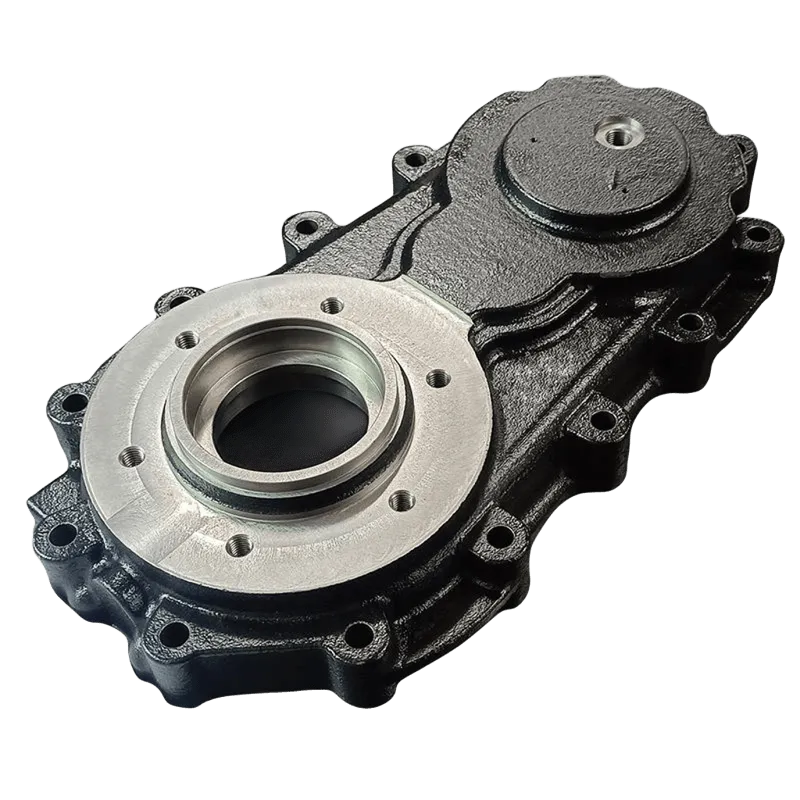




Cold chamber die casting is a well-established method for producing high-precision metal components at scale. It injects molten metal into a hardened steel die under high pressure, enabling efficient production of complex geometries with consistent accuracy and quality.
This article outlines the cold chamber die casting process, its key systems, and how it compares to other die casting methods.
Definition of Cold Chamber Die Casting
Cold chamber die casting is a high-pressure metal casting process in which molten metal is poured into a shot sleeve (shot chamber) and injected into a closed die using a hydraulic or mechanical plunger.
Cold chamber systems are ideal for aluminum and other high-melting-point alloys, making them essential in industries such as automotive, agriculture, construction, and industrial equipment. When applied correctly, cold chamber die casting provides a balance of mechanical performance, cost efficiency, and production stability that is hard to achieve with other casting or machining methods. For example, automotive component costs can range from $0.50 to $1.50 per part, depending on volume and complexity, while aluminum alloys typically achieve tensile strengths between 250 and 310 MPa. This balance enables manufacturers to optimize both quality and cost.
The term “cold chamber” refers to the separation of the injection system from the molten metal, not to a low operating temperature. This design differentiates cold chamber die casting from hot chamber die casting and significantly affects alloy selection, cycle time, and production efficiency.
Main Components of a Cold Chamber Die Casting Machine
A cold chamber die casting machine consists of several integrated systems, each responsible for a stage of the casting cycle. Understanding these components helps buyers and engineers assess machine capability and suitability.
The injection system includes the plunger (or piston), hydraulic drive, and control unit. Its role is to push molten metal from the shot chamber into the die cavity at controlled speed and pressure. Injection speed influences metal flow, turbulence, and the risk of air entrapment. Low-speed, high-pressure settings help produce compact, dense components with minimal porosity, ideal for parts needing high strength and integrity. High-speed, moderate-pressure settings can be used for complex geometries and thin walls, improving production speed and reducing cycle times but may increase the risk of air entrapment. Understanding these dynamics allows manufacturers to fine-tune injection parameters for optimal results. If porosity or air entrapment is observed, reduce injection speed and increase pressure to enhance metal density. Also, ensure vents are clear to allow gases to escape and consider adjusting mold temperature to improve metal flow.
Shot Chamber / Shot Sleeve
The shot chamber, or shot sleeve, is a cylindrical steel chamber that temporarily holds molten metal before injection. Molten metal is ladled into the shot sleeve at the start of each cycle, then the plunger advances to seal and inject the metal into the mold. The die consists of two halves mounted on the machine’s stationary and moving platens. Inside the die is the mold cavity, which defines the part’s final shape. The design also integrates runners, gates, vents, and cooling channels that control metal flow and solidification.
Clamping System
The clamping system provides the force needed to keep the die halves tightly closed during injection. If clamping force is insufficient, molten metal can force the die open, causing flash, dimensional defects, or surface quality issues. Clamping force selection is a critical machine-sizing parameter.

Cold Chamber Die Casting Proces
The cold chamber die casting process begins with molten metal prepared in a separate furnace, where alloy composition and temperature are carefully controlled. Once the metal reaches the target pouring temperature, it is transferred into the shot chamber using manual or automated ladling systems. This step distinguishes cold chamber die casting from hot chamber systems and directly influences cycle time and thermal stability. For example, the external ladling process in cold chamber systems takes about 3 seconds, compared to 0.3 seconds in hot chamber systems, showing the time penalty from this separation.
After the shot chamber is filled, the plunger advances to seal the metal and initiate injection. Molten metal is then forced. After the shot chamber is filled, the plunger advances to seal the metal and begin injection. Molten metal is forced into the die cavity at high velocity, filling intricate features and thin walls within milliseconds. Precise control of injection speed and pressure is essential to minimize air entrapment and ensure uniform filling. Intensification pressure is then applied to compensate for metal shrinkage during solidification, ensuring the casting retains its intended dimensions. The casting remains under pressure until it cools enough to achieve structural integrity. The die then opens, ejector pins release the solidified part, and the machine resets for the next cycle. This controlled sequence enables high repeatability across large production volumes while maintaining tight dimensional tolerances.
Why Aluminum Is Commonly Used in Cold Chamber Die Casting
Aluminum alloys are the most commonly processed materials in cold chamber die casting. Their high melting temperature makes them unsuitable for hot chamber systems, and their strength-to-weight ratio and corrosion resistance make them ideal for structural and functional parts.
Magnesium alloys are also compatible with cold chamber machines, particularly when lightweight performance is critical. Commonly used magnesium alloys include AZ91 and AM60, which offer good strength and corrosion resistance. Certain copper alloys, such as C86300 and C87800, can also be cast, though they require careful control due to higher thermal and mechanical loads on the tooling.
Clamping Force and Cycle Time Considerations
Clamping Force Calculation
Clamping force is a key factor in selecting a cold chamber die casting machine and maintaining process stability. It must counteract the metal-injection pressure acting on the projected area of the casting and runner system. In practice, the clamping force is calculated as F = P × A, where F is the clamping force, P is the required injection pressure, and A is the projected area. Insufficient clamping force can cause flash, die separation, and increased mold wear, while excessive force raises machine cost and energy use without improving quality.
Clamping Force=800 kg cm2×120 cm2=96,000 kg or approximately 96 tons
Cycle Time Components
Cycle time in cold chamber die casting depends on metal transfer time, injection speed, solidification, and cooling efficiency. Cold chamber machines usually have longer cycle times than hot chamber systems due to external ladling and the higher thermal mass of aluminum alloys. Optimized die design, efficient cooling channels, and stable process parameters can reduce cycle time while maintaining casting quality. Preheating dies, automating ladling, and integrating rapid cooling and monitoring can further improve efficiency. In production planning, cycle time should be considered alongside yield rate and secondary processing requirements.

Advantages of Cold Chamber Die Casting
Cold chamber die casting is widely used for aluminum and other high-melting-point alloys because it offers a combination of material flexibility, mechanical performance, and production consistency that many alternative manufacturing processes cannot achieve. When properly applied, this process provides several practical advantages in industrial production.
Scalability for medium- to high-volume production
Although cycle times are longer than those of hot chamber die casting, cold chamber systems provide stable and repeatable output over extended production runs. For aluminum components, this balance of quality and throughput makes cold chamber die casting a practical and scalable manufacturing solution.
Compatibility with high-melting-point alloys
Cold chamber die casting is specifically designed for aluminum, magnesium, and certain copper alloys. Keeping the injection system separate from the molten metal reduces thermal and chemical damage to machine components, enabling stable long-term production of aluminum parts that cannot be processed on hot chamber systems.
High mechanical strength and internal density
The high injection and intensification pressures used in cold chamber die casting help minimize shrinkage and improve metal density. This results in castings with reliable mechanical properties, making the process suitable for structural and load-bearing components.
Excellent dimensional accuracy and repeatability
Hardened steel dies and controlled process parameters allow cold chamber die casting to maintain tight tolerances across large production volumes. Consistent part dimensions reduce the need for extensive secondary machining and simplify downstream assembly.
Capability to produce complex geometries
Cold chamber die casting supports intricate features such as ribs, bosses, thick-to-thin wall transitions, and integrated functional elements. This design flexibility enables engineers to consolidate multiple parts into a single casting, reducing assembly steps and overall system complexity.
Comparison with Hot Chamber Die Casting
The main difference between cold chamber die casting and hot chamber die casting is furnace placement and metal delivery. Hot chamber machines integrate the injection system into the molten metal bath, enabling faster cycles but limiting alloy selection.
| Comparison Factor | Cold Chamber Die Casting | Hot Chamber Die Casting |
| Furnace Location | Furnace is external to the machine; molten metal is ladled into the shot sleeve for each cycle | Furnace is integrated into the machine; injection system is submerged in molten metal |
| Cycle Time | Typically 30–90 seconds per shot (aluminum parts commonly 45–70 seconds) | Typically 5–30 seconds per shot (zinc parts often 8–15 seconds) |
| Alloy Compatibility | Aluminum alloys, magnesium alloys, certain copper alloys | Zinc alloys (Zamak series), limited low-temperature magnesium alloys |
| Injection Pressure | High pressure, usually 30–120 MPa, required to fill higher-viscosity molten aluminum | Lower pressure, typically 10–35 MPa, due to excellent zinc fluidity |
| Mold / Die Life | Shorter die life due to thermal shock; usually 80,000–150,000 shots for aluminum | Longer die life; commonly 300,000–1,000,000 shots for zinc |
| Production Output | Medium to high volume; optimized for structural and functional components | Very high volume; optimized for small, repetitive parts |
| Part Complexity | Suitable for thicker walls, ribs, load-bearing features, and structural geometry | Best for thin-walled, small, high-precision parts |
| Surface Finish & Post-Processing | Good surface quality; compatible with CNC machining, powder coating, anodizing | Excellent surface finish; ideal for electroplating and decorative finishes |
| Safety Considerations | Higher exposure risk due to molten metal transfer; strict process control required | Safer day-to-day operation with enclosed molten metal system |
| Initial Equipment Cost | Higher initial investment due to larger machines and higher mold cost | Lower initial investment and longer mold life |
Suitable Applications of Cold Chamber Die Casting
Cold chamber die casting machines are commonly used to produce:
Automotive housings, brackets, and transmission components
Agricultural and construction machinery parts
Industrial equipment enclosures
Structural aluminum components requiring tight tolerance
One application of cold-chamber die casting is the production of drone frames. Using this method, a leading drone manufacturer achieved a 40% weight reduction, significantly enhancing flight performance and battery life. This highlights the potential for cold chamber die casting to revolutionize component design in emerging technologies.
These applications typically demand repeatable quality, load-bearing strength, and compatibility with secondary machining or surface treatments. To ensure process reliability and extend the longevity of cold chamber machines, regular maintenance is crucial. Key practices include inspecting and replacing worn parts, cleaning and lubricating moving components, and checking hydraulic and electrical systems for signs of wear or damage. Following these routines helps maintain optimal machine performance and minimize downtime.

FAQ
How do production rates in cold chamber die casting compare to other casting processes?
Cold chamber die casting generally achieves higher production rates than gravity or sand casting, but lower rates than hot chamber die casting. The added time for molten metal transfer increases cycle time, yet the process still supports efficient mass production with consistent quality. Compared to CNC machining from solid material, cold chamber die casting offers much higher output once tooling is established.
What is a hot and cold chamber?
A hot chamber die-casting machine submerges its injection system into molten metal and is mainly used for low-melting-point alloys such as zinc. A cold-chamber die-casting machine keeps molten metal separate from the injection system and is used for higher-melting-point alloys such as aluminum, magnesium, and copper. The choice between them depends on material, production volume, and part requirements.