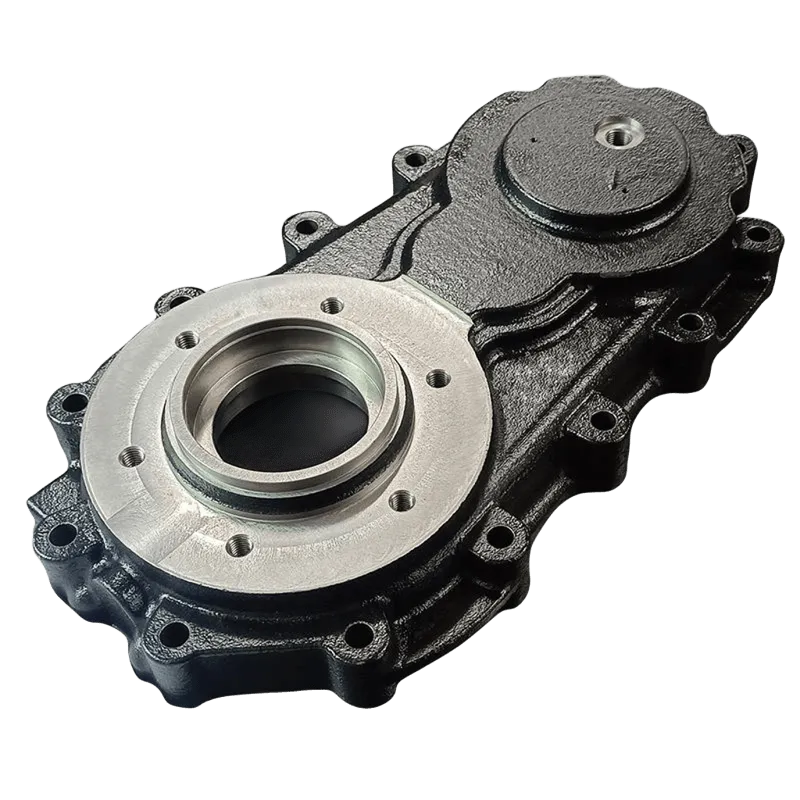

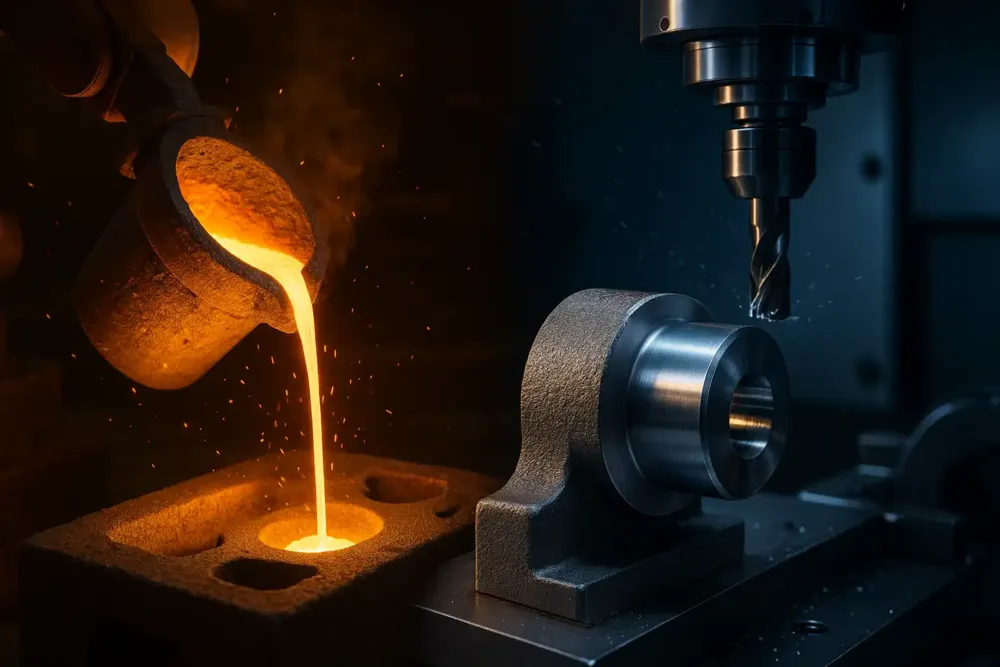
The decision between casting and machining directly affects your project’s costs and delivery schedule. Choosing the right process lowers unit costs, shortens lead times, and reduces production missteps, while the wrong choice can cause unnecessary expenses or delays. This is not just a technical preference but a production strategy that determines tooling costs, tolerance control, quality stability at scale, and how quickly your part moves from drawing to manufacturing.
A part that seems inexpensive at first can become costly when secondary operations, scrap risk, or longer cycle times are considered. The most reliable approach is to evaluate the part’s geometry, performance requirements, and order volume, then select the process that best meets those needs.
To set the stage for this decision, the following guide outlines the fundamentals of casting and machining, highlights the strengths and trade-offs of each method, and provides guidance to help buyers avoid common sourcing mistakes when selecting a process for custom metal components.
What Is Casting?
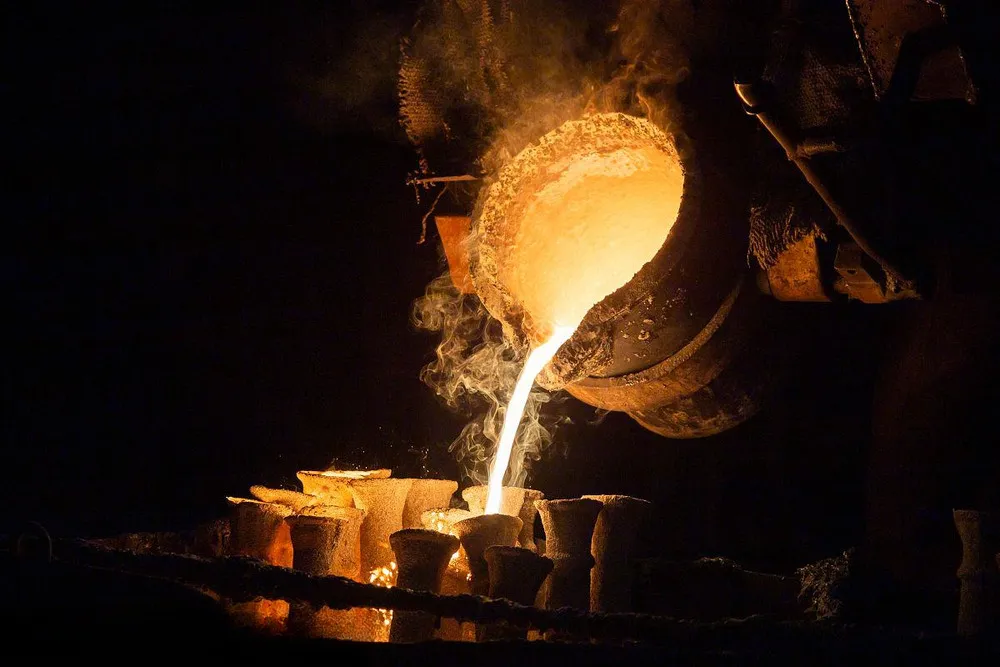
Casting involves pouring molten metal into a mold, where it solidifies into the desired shape. Each casting method presents specific quality risks, such as porosity, shrinkage cavities, surface roughness, and dimensional distortion. The likelihood and severity of these defects depend on the casting process, part geometry, alloy selection, and process control. Understanding these issues helps buyers and engineers align the process with the part’s performance and reliability needs. Casting is typically chosen for components with complex geometry, internal cavities, or near-net shapes that would be inefficient to machine from solid stock. It is commonly used for the main bodies of housings, enclosures, and structural parts, with critical interfaces often finished by machining. The selected casting method directly influences cost, achievable quality, and the extent of downstream machining required. The following are several common die casting processes:
Sand Casting
Sand casting uses a sand mold and is typically applied to larger parts or moderate volumes where permanent tooling is not cost-effective. It accommodates a wide range of alloys and part sizes, making it suitable for industrial housings and bodies. However, it offers looser tolerances and rougher surfaces, so functional faces, bores, and threads often require machining afterward.
Die Casting
Die casting injects molten metal into a steel die under high pressure, typically for aluminum, zinc, or magnesium alloys. It is well-suited for medium-to-high volume production due to its repeatability and fast cycle times. However, tooling investment is significant, and design changes are costly after the die is produced. This method is most effective when the part geometry is stable, and volumes justify the initial expense.
Squeeze Die Casting
Squeeze die casting applies pressure during solidification to reduce shrinkage defects and improve density. It is chosen when a cast part needs better mechanical consistency or greater pressure integrity than conventional die casting provides. Because of its narrower process window and higher execution requirements, supplier capability and process control are especially critical.
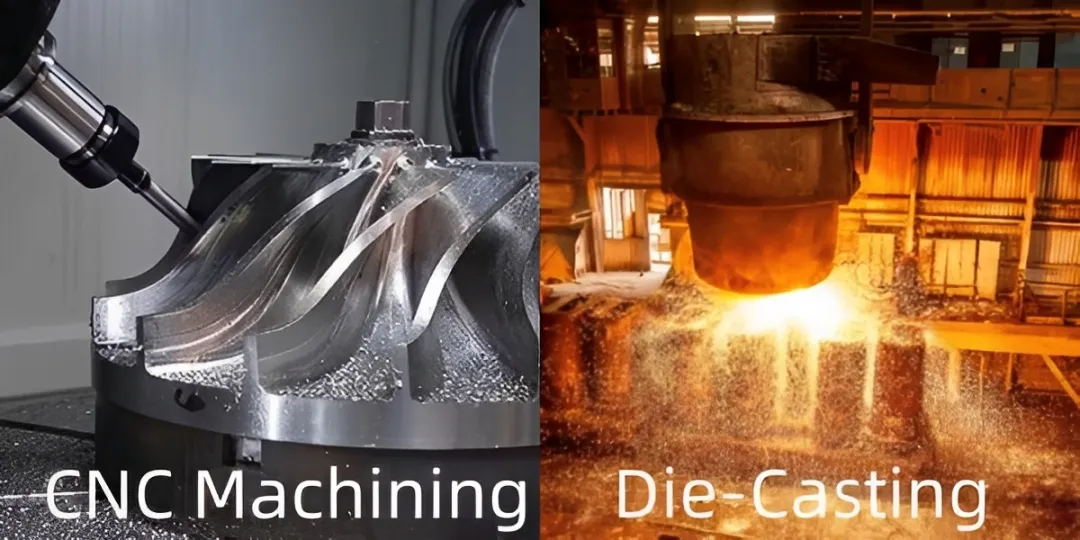
What Is Machining?
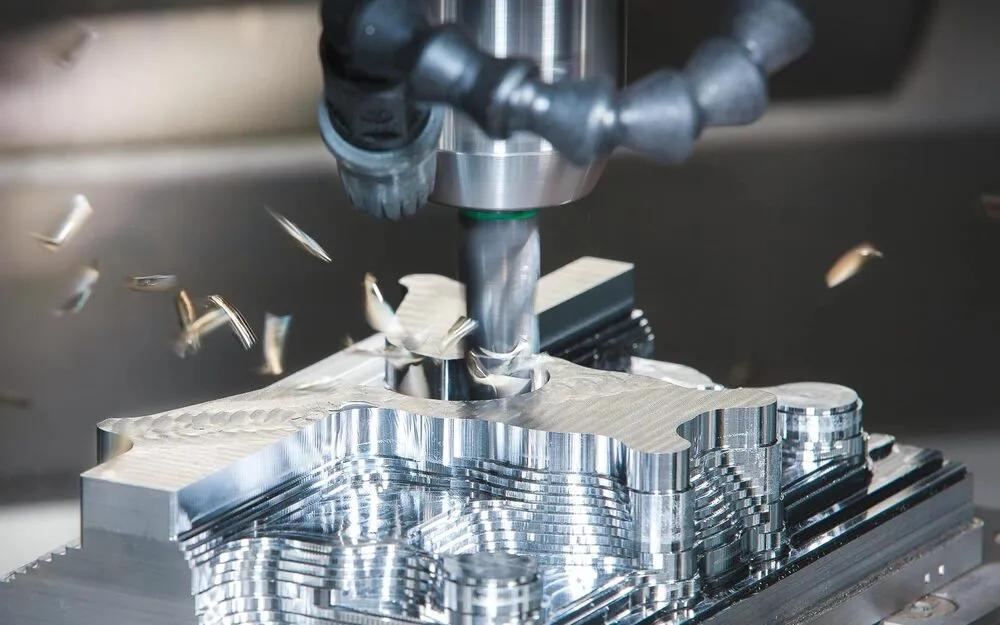
Machining creates parts by removing material from solid stock or preforms using controlled cutting operations. It is preferred for tight tolerances, precise interfaces, or rapid design changes. Machining is commonly used for low volumes, prototypes, and as a finishing method for critical surfaces on cast parts. Cycle time is the main cost driver; each additional minute on the machine can increase costs by 2 to 3 percent, depending on rates and setup. Efficiency depends on part geometry and the volume of material to be removed.
CNC Machining
CNC machining uses programmed toolpaths to achieve consistent dimensional control. It is widely used for prototypes, low-to-medium volumes, and parts with functional features such as sealing faces, bearing seats, precise bores, and threaded interfaces. While it offers high precision and flexibility, costs rise when large amounts of material must be removed to create hollow or complex shapes.
Common Operations in Machining
Machining typically involves a combination of milling, turning, drilling, and occasionally grinding. Milling forms faces, pockets, and contours; turning produces rotational features; drilling creates holes for fastening or fluid passage; and grinding is used for high-precision fits or fine surface finishes. These operations are often applied selectively, especially when finishing only the critical areas of a casting.
FERR offers both casting and CNC machining for custom metal components, with expertise in casting-led production for complex geometries and scalable output. Whether you need a cost-effective near-net shape, tight-tolerance features, or a hybrid approach, we can help you determine the most practical process plan before costs are finalized in the design.
Need help selecting the right formed wire for your overhead line project? FERR is a professional Formed Wire Manufacturer and Supplier specializes in high-performance formed wire solutions tailored to utility and telecom applications. From armor rods to dead-end grips, we provide expert support, strict QC, and global supply. Contact us now to get technical advice or request a quote today.
Send your drawing for a fast manufacturability review and quotation.
What Are the Advantages and Disadvantages of Casting and Machining?
This comparison is important because the process choice affects not only manufacturing cost but also project risk, quality, stability, material usage, and the extent of secondary operations required. While it is natural to seek a definitive answer on which method is best, there is no universal solution. The key is to determine which method delivers the best outcome for the specific part, quantity, and performance requirements.
Before reviewing the details, it helps to compare the methods at a glance.
Casting vs. Machining at a Glance
| Factor | Casting | Machining |
| Best for | Complex shapes, medium to high volumes | Tight tolerances, low volumes, design flexibility |
| Upfront cost | Higher due to tooling or mold development | Lower, usually no dedicated mold required |
| Unit cost at scale | Often lower once volume increases | Often higher because machine time repeats part by part |
| Dimensional accuracy | Moderate, usually needs finish machining on critical areas | High, especially for precision features |
| Surface finish | Depends on process, often rougher than machining | Better and more controllable |
| Material range | More limited by castability and process type | Broad range of wrought and engineering materials |
| Shape complexity | Strong for cavities, ribs, integrated forms | Strong for precise features, weaker for hollow near-net shapes |
| Material utilization | Better for near-net-shape parts | Lower when much stock must be removed |
| Design changes | Slower and more expensive after tooling is made | Easier through program and fixture updates |
| Typical ideal use | Housings, bodies, enclosures, structural forms | Precision interfaces, prototypes, shafts, critical fit parts |
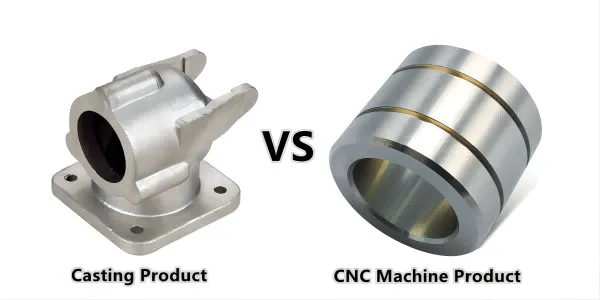
Advantages of Casting
Suitability for High-Volume Production
Casting is highly effective when the same part must be produced repeatedly in medium to large volumes. Once the mold or die is developed, the process becomes efficient and repeatable, allowing manufacturers to produce large quantities with stable unit costs. This is especially valuable for products such as housings, covers, brackets, and structural bodies, where demand is ongoing.
In large-scale production, casting often offers a stronger cost advantage than machining because the basic shape is formed in a single process cycle. Instead of removing large amounts of material from a solid block, the process begins closer to the final geometry. That efficiency becomes more meaningful as production quantity increases.
Capability for Complex Geometries
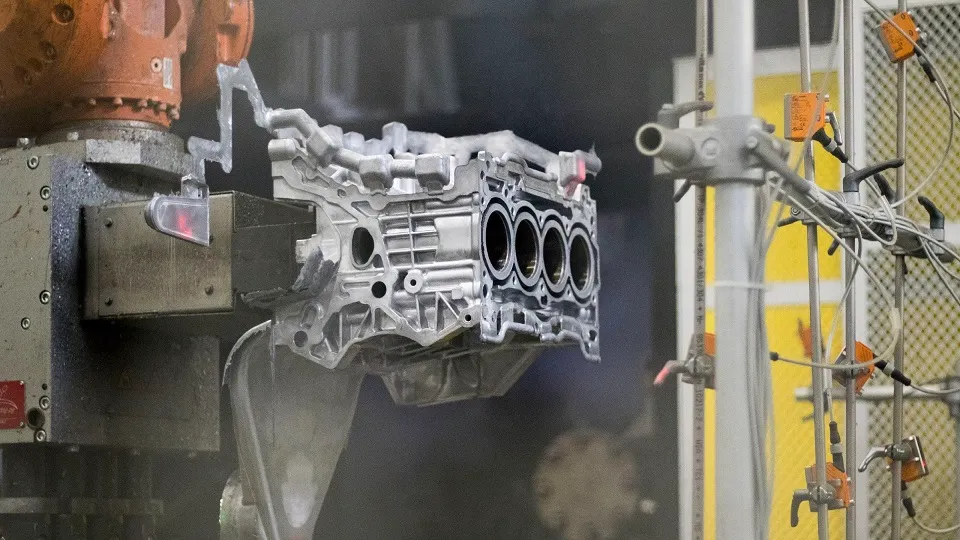
Casting is well-suited to parts with shapes that would be difficult, slow, or uneconomical to machine from solid stock. Internal cavities, curved passages, ribs, bosses, and integrated forms can often be created directly in the mold. This makes casting particularly useful for components such as valve bodies, pump housings, motor covers, and other parts with three-dimensional complexity.
A cast design can reduce the need for multi-piece assemblies. Instead of machining several parts and fastening them together, manufacturers can form an integrated structure in one casting, simplifying assembly and improving consistency.
High Design Flexibility
Casting offers flexibility in shape and structural design. It allows engineers to incorporate features into the part itself rather than relying on later fabrication steps. This is one reason cast components are widely used when the part must combine function, enclosure, support, and form in a single body.
This flexibility is valuable during the product development of complex parts. If the target geometry cannot be produced efficiently through subtractive processing alone, casting often provides a more practical foundation. In that sense, casting supports design freedom in a way that machining does not always match economically.
Improved Material Utilization
Casting uses material more efficiently than full machining for complex or hollow parts. Because molten metal fills the mold to create a near-net shape, less raw material needs to be removed afterward. This is especially important when the part is large, the alloy is expensive, or the geometry would generate excessive chips during machining.
Better material utilization contributes to improved production economics. Although cast parts may still require finish machining, overall waste is much lower than with parts fully machined from billet.
Disadvantages of Casting
Limited Dimensional Precision
Casting cannot match machining’s dimensional accuracy, especially on critical fits or interfaces. Most as-cast parts hold tolerances around ±0.3 mm to ±0.5 mm, while machined features can reach ±0.01 mm or better. Because cast parts have wider tolerances, precision surfaces often require secondary machining.
This limitation matters in assemblies where dimensional variation affects performance. A cast part may be acceptable in overall shape but still fail to meet functional requirements if the key interfaces are not tightly controlled. Buyers who overlook this often underestimate the true finishing cost.
Restricted Material Options
Casting does not offer the same freedom of material selection as machining. In practice, the available alloy range depends on the casting method, mold system, metal’s thermal behavior, and filling characteristics. Some materials machine well from wrought stock but are less suitable, less stable, or less economical to cast.
This becomes important when the application demands specific mechanical properties, corrosion resistance, or structural reliability. In such cases, material choice may narrow the viable casting options more than expected. The process cannot be separated from the alloy decision.
Lower Surface Finish Quality
Casting usually produces a rougher surface than machining, particularly in sand casting. Even processes with better as-cast surface quality may still fall short when the part requires smooth sealing zones, cosmetic consistency, or low roughness values for functional reasons. As a result, extra finishing may be necessary.
Surface quality is not only an aesthetic matter. In many industrial parts, it affects sealing, coating adhesion, wear behavior, and assembly fit. If the required surface condition is high, relying on the as-cast finish alone is unrealistic.
Longer Development and Production Preparation Cycles
Casting usually requires more preparation before production can begin. Patterns, molds, or dies must be designed, produced, tested, and adjusted before the process becomes stable. This development stage increases lead time at the front end of the project, especially for new parts. While this is less of a problem in repeat production, it becomes a disadvantage when the design is still changing or when parts are needed quickly. Compared with machining, casting is generally less agile in the early phase of product development.
Advantages of Machining
Superior Dimensional Accuracy
Machining is the stronger choice when the part must meet tight tolerances and consistent dimensional requirements. CNC-controlled operations can achieve high precision on bores, sealing faces, threads, and mating surfaces, making machining suitable for components that must fit reliably in mechanical assemblies.
This precision is one of the main reasons machining remains essential even when a part is initially cast. Critical features often cannot be entrusted solely to the forming process. When fit and function depend on exact dimensions, machining provides a more reliable level of control.
Broad Material Versatility
Machining supports a wide range of materials, including aluminum, steel, stainless steel, brass, copper, titanium, engineering plastics, and many specialty alloys. This versatility makes it easier to select material based on performance requirements rather than process limitations. For many engineers and buyers, that freedom is decisive.
It also allows machining to support prototype development and technical validation more easily. A part can be produced from the final intended material without waiting for casting tooling or adjusting the design for foundry constraints. That makes the development path more direct.
Strong Process Flexibility Without Dedicated Tooling
Machining does not require a dedicated mold or die for every new design. This makes it flexible for prototypes, custom parts, engineering changes, and low-volume orders. If the design evolves, the process can usually adapt through updated programming and fixturing rather than a complete tooling rebuild. For example, one project faced a critical last-minute design change just before production; instead of delaying the schedule, the team reprogrammed the CNC machine overnight and shipped revised parts the next morning. This kind of agility lets companies respond to late changes quickly and keep projects moving without costly setbacks.
That flexibility reduces both risk and commitment in the early stages of a project. It also gives buyers greater room to refine the part before locking in a long-term production method. In uncertain or changing projects, this is a major advantage.
Lower Initial Cost for Small Batches
For low-volume production, machining often has a lower entry cost. There is no major investment in dies or patterns, so the first batch can move forward with less upfront expense. This makes machining practical for spare parts, pilot runs, validation samples, and specialized components ordered in small quantities.
The cost structure is simple: material, machine time, tooling wear, and inspection. That transparency is useful when demand is uncertain or when a company wants to test the market before committing to dedicated tooling. For small batches, machining is often the more rational option.
Disadvantages of Machining
Higher Cost in Volume Production
Machining becomes less economical when quantities increase, and the same geometry must be repeated at scale. Since each part requires machine time, cutting operations, and material removal, the cost per part remains relatively dependent on cycle time. In contrast, a cast process can often lower unit cost more effectively once tooling is amortized. A helpful rule of thumb is this: if the estimated chip volume (the percentage of the starting billet that becomes waste) exceeds 60 percent, or if your part design requires removing more than half of the raw material to reach net shape, it is time to explore casting. This simple screening check can quickly indicate when machining costs will start to escalate, helping avoid late-stage surprises.
Increased Material Waste
Machining is a subtractive method, so material waste is inherently higher than in many casting applications. When the final part is produced from billet or bar stock, a substantial portion of the original material may be cut away and turned into chips. For simple geometries, this is manageable, but for hollow or highly contoured parts, it can become excessive.
That waste affects more than raw material cost. It also influences cutting time, tool wear, coolant use, and overall production efficiency. In parts where the final form is far from the starting stock shape, machining can become an expensive way to create scrap before making the product.

Casting and Machining: Choosing the Best Method
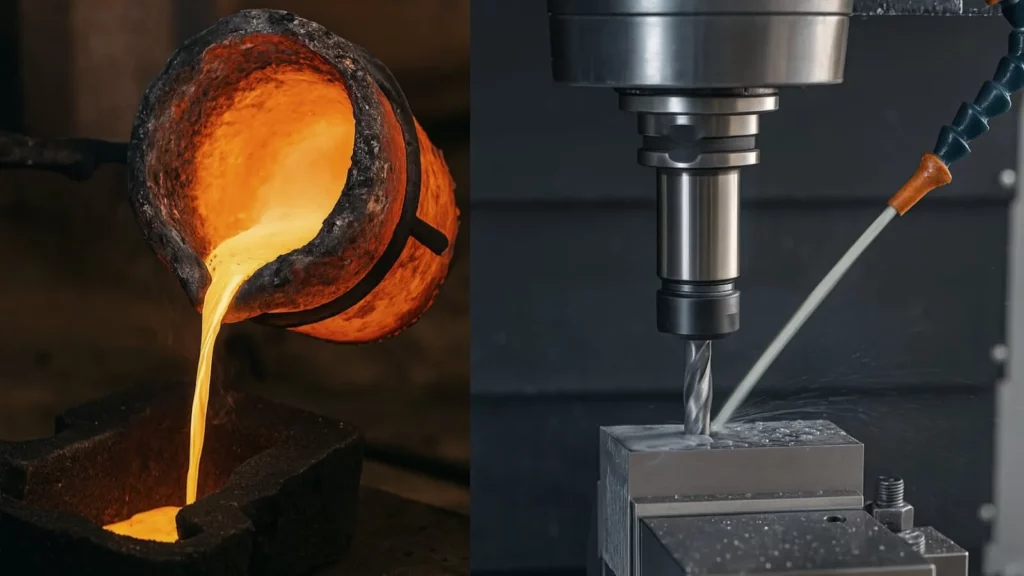
The best process is determined by need, not preference. A sourcing team that starts with the wrong manufacturing assumption usually ends up paying for it later through longer lead times, redesigns, scrap, or unnecessary finishing operations. The sensible approach is to match the process to the part’s actual requirements. Once that happens, the answer is often less mysterious than it first appears.
If You Need Complex Shapes at Scale, Casting Is the Best Solution
If your part includes internal cavities, ribs, curved passages, or integrated structures that would be wasteful to cut from solid stock, casting is usually the best solution. As a practical rule of thumb, if your part has more than three distinct internal features (such as hidden cavities or undercuts), or if the ratio of internal volume to solid volume is greater than 15 percent, casting becomes a more efficient choice than machining. This measurable threshold can help quickly screen designs likely to yield the cost and complexity advantages of casting. This is especially true for housings, bodies, enclosures, and structural forms used in repeat production.
Casting becomes more attractive as the quantity increases. Once volume is high enough to absorb tooling cost, the per-part economics often become stronger than full machining.
If You Need Tight Tolerances and Precision Features, Machining Is the Best Solution
If the part depends on accurate bores, flat sealing surfaces, close alignment, controlled threads, or strict dimensional consistency, machining is usually the best solution. These are the features that most directly affect assembly and performance.
When the failure mode is fit-related rather than shape-related, machining gives more reliable control. It is often the safer route for functional precision.
If You Need Low-Volume Production or Ongoing Design Changes, Machining Is the Best Solution
If order quantities are small or the drawing is still evolving, machining is usually the best solution. It avoids committing to tooling too early and allows faster changes during prototyping or pilot production.
This reduces risk at the development stage. For many projects, that flexibility matters more than small differences in theoretical piece cost.
If You Need Better Material Efficiency for Large or Hollow Parts, Casting Is the Best Solution
If machining the part from billet would remove a large amount of material, casting is usually the best solution. It produces a near-net shape, reducing waste and shortening unnecessary cutting time.
This is common in pump housings, casings, brackets with deep pockets, and other parts where the final form is far from the starting stock shape. In those cases, casting often makes the overall process more rational.
If You Need Wrought Material Properties or Broader Alloy Freedom, Machining Is the Best Solution
If the application requires wrought stock, highly uniform internal properties, or a specific alloy that is not a practical casting choice, machining is usually the best solution. It allows the part to be produced directly from bar, billet, or plate.
That matters in some high-stress, corrosion-sensitive, or material-critical applications. In those cases, process freedom follows material logic rather than just shape logic.
If You Need Both Shape Efficiency and Functional Precision, a Hybrid Route Is the Best Solution
If the part has a complex overall form but still includes critical precision features, a hybrid route is usually the best solution. The casting creates the main shape economically, and machining finishes only the features that truly require tighter control.
This is one of the most common solutions in industrial parts production because it balances cost and performance. At FERR, this is often the most practical route for custom parts: casting handles the main geometry, while machining is reserved for bores, sealing surfaces, threads, and other critical interfaces.
If you are deciding between casting, machining, or a hybrid route, the fastest way to avoid wrong assumptions is a short manufacturability review against your actual drawing. In this review, you can expect direct feedback on your part’s design, identification of the main cost drivers, and a summary of process risks. FERR will compare both process routes and walk you through adjustments that could reduce cost or simplify production, so you get a clear, actionable recommendation before making a commitment. We’ll recommend the most cost-effective process plan based on geometry, tolerances, material, and annual volume.
Need help selecting the right formed wire for your overhead line project? FERR is a professional Formed Wire Manufacturer and Supplier specializes in high-performance formed wire solutions tailored to utility and telecom applications. From armor rods to dead-end grips, we provide expert support, strict QC, and global supply. Contact us now to get technical advice or request a quote today.
FAQ
casting vs machining cost
Machining is usually cheaper upfront because it requires little to no tooling, making it a good fit for prototypes and low volumes. But unit cost can rise quickly if the part needs a long cycle time or heavy material removal.
Casting often costs more at the beginning due to tooling, but becomes more economical in repeat production—especially for complex, near-net shapes. The “best” choice depends on the total cost, including tooling, secondary machining, scrap risk, inspection, and lead time.
casting vs machining strength
Strength depends on alloy selection, part design, and process quality—not just the process name. Machined parts from wrought stock often have more uniform properties and lower defect sensitivity, which can be safer for highly stressed components.
Cast parts can still be very strong when designed and produced correctly, and processes like squeeze casting can improve density and reduce porosity. The practical question is whether the part is defect-sensitive (fatigue, pressure-tight, sealing) and what verification (testing/inspection) is needed.