

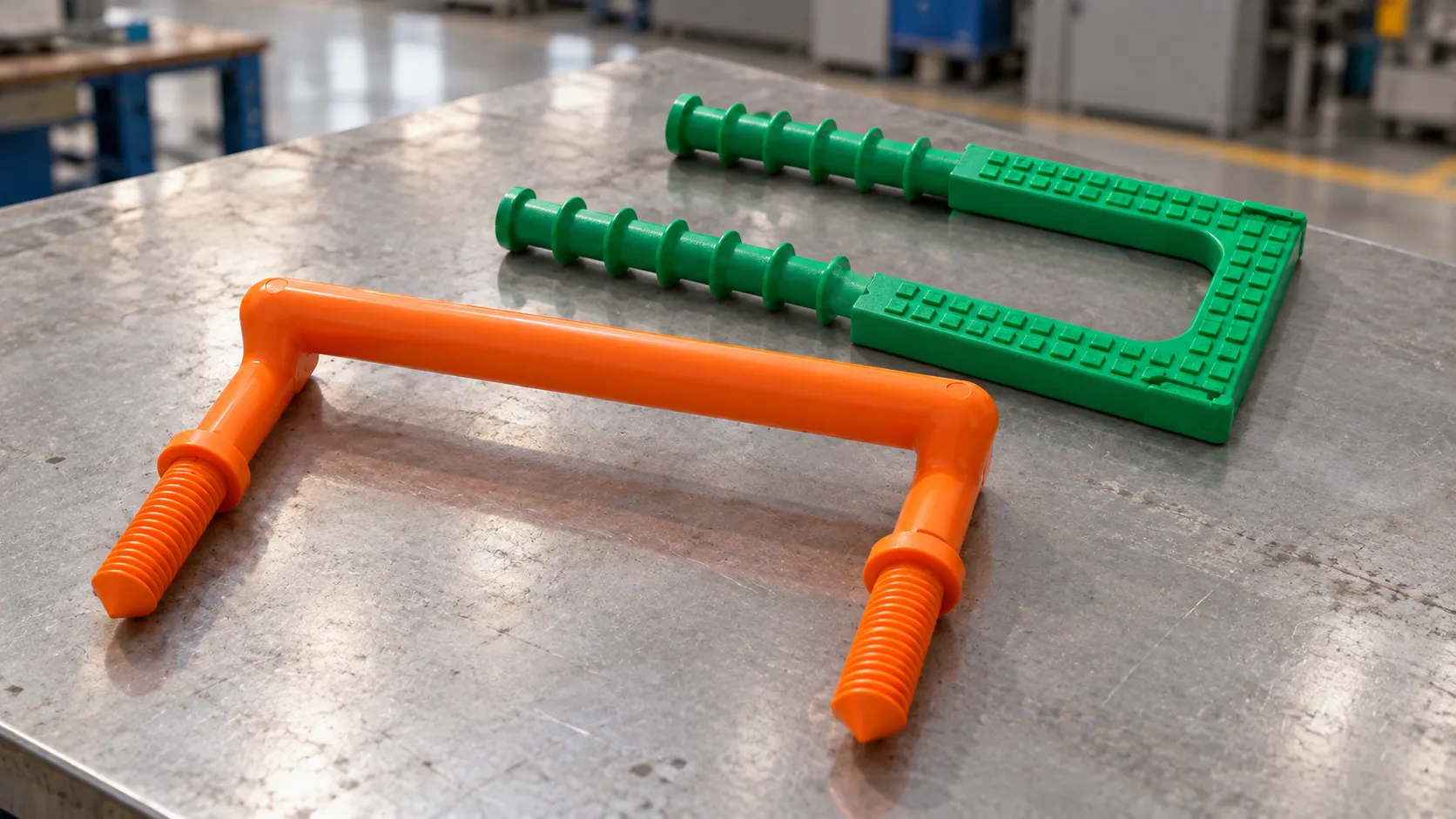
A defect in a sample costs you one step. Put the same defect in a bulk order and it shows up in every step in the container.
That’s the whole case for being careful. And in our experience with custom metal parts, the defect is rarely the metal. Far more often it’s the fit. The leg centres sit a few millimetres off the mould insert, or the coating thins out at the bend, or the test report on file was done on a different model.
This guide is for importers, distributors, precast concrete manufacturers and project procurement teams choosing a manhole step manufacturer for a bulk order. Each section is one check, in the order we’d run them from the buyer’s side: technical fit, then quality evidence, then whether the factory can repeat the result, then the RFQ.
Define Your Project Requirements Before Choosing a Manufacturer
Before you contact anyone, pin down where the step goes, how it’s fixed and which dimensions you can’t change. If you skip this, five suppliers will quote five different products, and their prices won’t be comparable.
Identify the Application and Installation Conditions
Sewer manholes, stormwater pits and precast concrete chambers aren’t interchangeable, so write down which one you’re buying for.
Then decide how the step gets into the wall. It can be cast in at the precast plant, pushed into a pre-formed insert, or fixed into drilled holes on site. New build or replacement matters here. On a new precast job, the step and the mould can still be adjusted to each other. On a replacement job the holes already exist, so the step has to match them.
Last, the exposure. An aggressive sewer atmosphere, salt air near the coast or contact with potable water can each change which materials the owner accepts.
Confirm Dimensions, Materials, and Order Volume
Matching the width alone won’t guarantee a fit. These are the dimensions that decide it:
- clear tread width
- core bar diameter
- leg length / embedment depth
- leg or hole centre distance
- projection from the wall
- the shape of the anchoring end
Use the names on your drawing, because owners label these differently. If the drawing has no tolerances, mark which dimensions are critical. It’s usually the leg centres and the anchoring end.
Then add the material (PP-coated steel, galvanized steel, cast or ductile iron, stainless), the project country, and whether you’re buying a one-off project quantity or an annual supply.
Minimum RFQ fields: dimensions or drawing · applicable standard and edition · one-off or annual volume · delivery destination
Not sure which dimensions can move? Our custom manhole steps page lists the ones we usually review against an existing installation.
Evaluate Material Quality and Corrosion Resistance
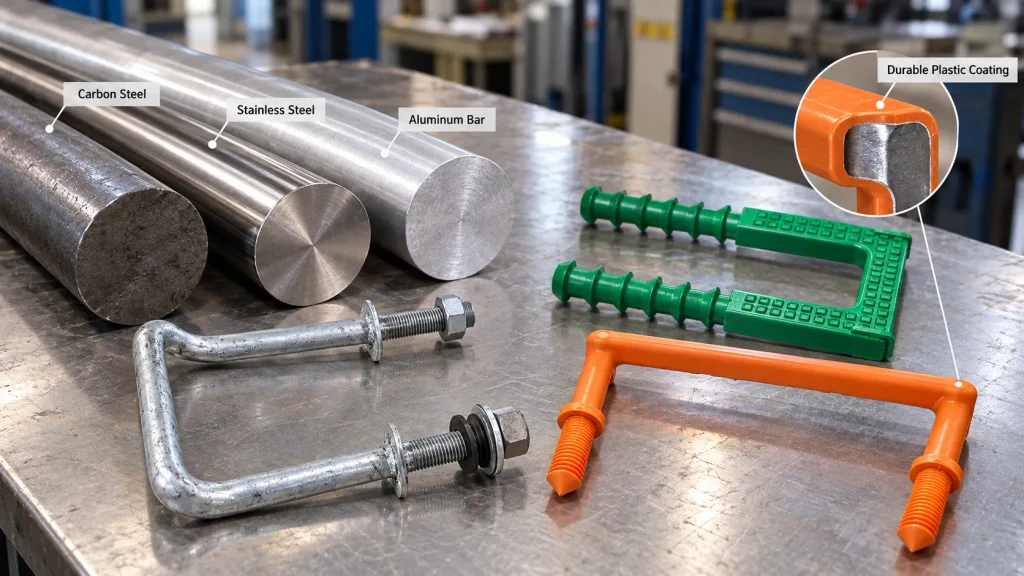
Use the material your owner’s specification accepts for that chamber, then verify the details behind the label. “PP-coated” or “galvanized” on a quote doesn’t tell you much by itself. For a direct comparison, see our PP-coated vs galvanized manhole steps guide.
Compare Common Manhole Step Materials
| Material | What to verify | Where it’s typically considered | Watch out for |
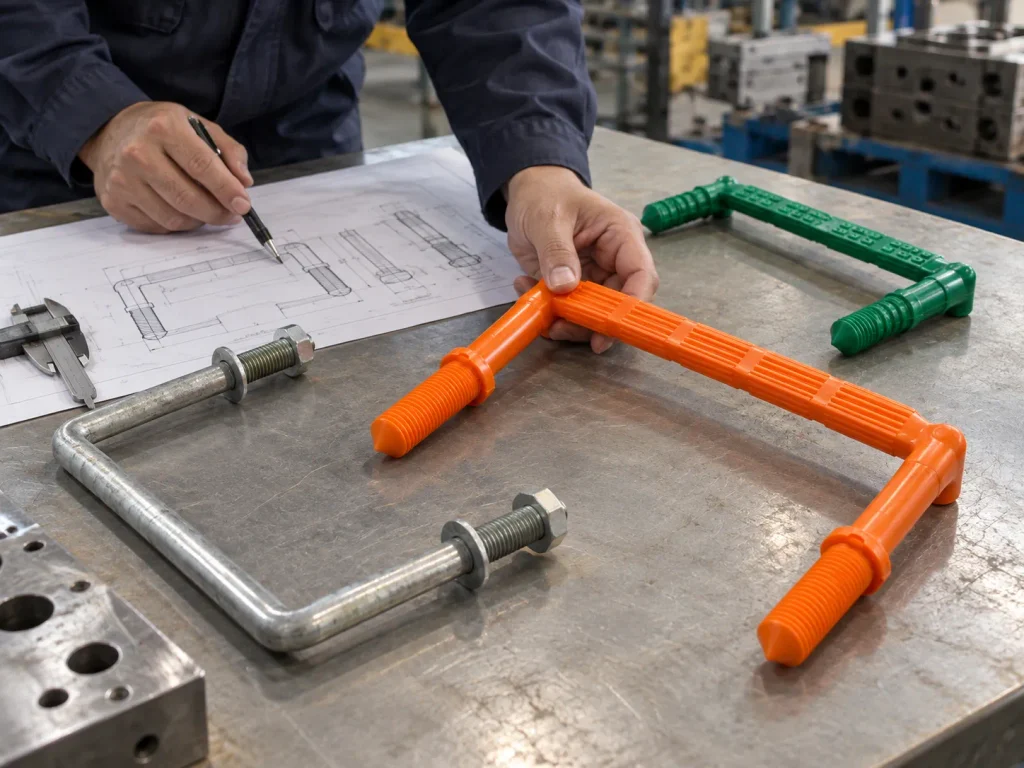
| PP-coated steel (steel core encapsulated in polypropylene) | Core bar grade and diameter; resin type; full encapsulation, especially where the legs enter the wall | Precast production; projects that specify encapsulated steps | “Plastic-coated” can mean PE as well as PP |
| Hot-dip galvanized steel | Coating spec and thickness record; whether the whole step is galvanized or only part of it | Where the spec allows it; some specs and installation guides treat sewer and stormwater separately | Check whether your owner accepts it for sewer chambers |
| Cast / ductile iron | Material grade, mechanical property records, casting defect checks | Replacing existing iron designs; markets where it’s still specified | Heavier, and corrosion resistance depends on grade and any coating |
| Stainless steel (304 / 316) | Grade on the mill certificate, traced to the heat number | Owner-specified, coastal or potable-water chambers | 304 is not a substitute when 316 is specified |
No one material wins everywhere, and New Zealand alone shows why. Watercare’s material standard lists accepted step products, with conditions on manhole diameter and depth. Kāpiti Coast District Council’s standard drawing CM-004 calls for 20 mm 316 stainless steel or an approved alternative. Those are two owners in one country with two different answers.
The label can also mislead. Hynds’ Pinnacle step, one of the best-known encapsulated steps in that market, uses PE over a galvanized core, not PP. If your spec says PP, confirm the resin before you accept the word “plastic”.
Check Material Traceability and Coating Consistency
Ask for material certificates showing chemical composition, mechanical properties and heat number. Also ask for batch traceability and incoming inspection records. A certificate only helps if it traces to the batch you’re receiving. That’s as true for a coated step as it is for ductile iron castings.
On coated samples, check for bare steel, cracks at the bends, and coating that’s thick on one leg and thin on the other. Cutting one sample open costs you a step and tells you more than a datasheet.
If a supplier cites ASTM D4101, it’s worth knowing what that standard covers. It classifies polypropylene materials, so it describes the resin. It doesn’t certify the finished step.
Verify Testing Standards and Product Compliance
Your project specification decides which standard applies, so start there and not with the supplier’s brochure. Then ask for test reports on the same model, using the same method and the same standard edition your project requires.
Understand Applicable Standards for Different Markets
The standards you’ll see most often don’t all work the same way:
- EN 13101 is a product standard for the step itself, covering steps for underground man-entry chambers (requirements, marking, testing and evaluation of conformity). It’s widely referenced in Europe and appears in some Middle East project specifications.
- ASTM C478/C478M is a US specification for precast reinforced concrete manhole sections, with steps and ladders covered as one section. It isn’t a stand-alone step certificate. The current edition is C478/C478M-26.
- AS 4198 in Australia is a standard for precast concrete access chambers for sewerage, and it was revised in 2022. Like C478, it deals with the step as part of the chamber.
On top of these, many water utilities and councils have their own specifications, and in practice that’s often the document that decides.
So when a quote says “complies with EN 13101 and ASTM C478”, ask which edition, which clause and which model. Better still, send the tender clause first and see how the supplier answers it.
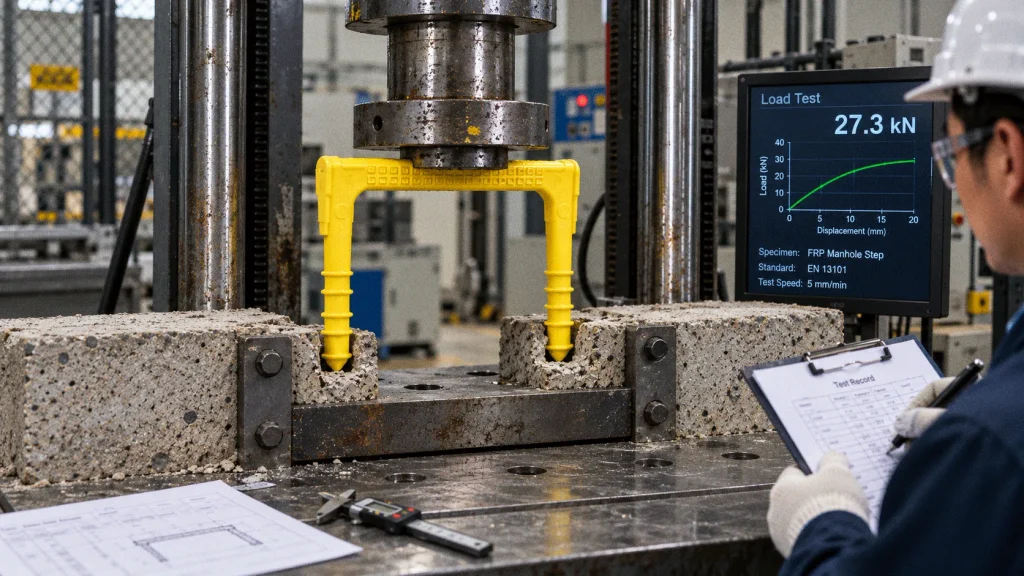
Request Evidence of Load, Pull-Out, and Impact Testing
Depending on your spec, the tests may cover vertical load, pull-out, impact and coating integrity. A report you can rely on names:
- the test method and standard edition
- the product model and sample ID
- the test date and the lab
- the result against the stated requirement
Read the whole report, because the cover page alone doesn’t tell you what was tested.
If a supplier has no report for your model, the useful answer is “not tested yet, here’s the plan and the cost”. That’s worth more than a report for a step that only looks similar. It also tells you to plan the testing time into your schedule now, rather than discovering it at approval stage.
Assess Manufacturing Capacity and Batch Consistency
A capacity figure tells you the factory can make enough steps. It doesn’t tell you the steps will match the sample. For that, ask how the factory ties every batch to the approved sample, and ask to see the records.
Understand the Manufacturing Process
A PP-coated step usually starts as a steel bar that’s cut and bent, sometimes welded, then over-moulded in an injection tool. A cast or ductile iron step is cast to shape and finished. A galvanized step is formed first and coated afterwards.
Ask which of those processes the factory does in-house and which are outsourced. Outsourcing on its own isn’t a red flag. Not knowing who does your coating, or how it’s checked when it comes back, is.
Evaluate Quality Control Across Production Batches
Here’s what the records should show:
- a first article signed off before batch release
- incoming checks on bar, resin or coating materials
- dimensional checks during forming and moulding
- final sampling on the critical dimensions each batch, the anchoring end most of all
- a nonconformance procedure that says what happens to out-of-tolerance parts
- traceability linking each shipment to its materials and inspection data
There’s one more question most buyers forget. Was the approved sample made on production tooling? A sample made in the toolroom can pass easily, and the first batch off the production mould can still drift. Ask, and ask whether the factory keeps the approved sample as a physical reference.
Since fit is where custom parts usually go wrong, our own inspection concentrates on the dimensions and anchoring features that decide fit, and production follows the latest approved drawing revision. You can see the wider process on our quality assurance page. For a first bulk order with any supplier, consider a pre-shipment inspection of your own as well. It’s cheap compared with a container of steps that don’t fit.
Check OEM Customization and Technical Support
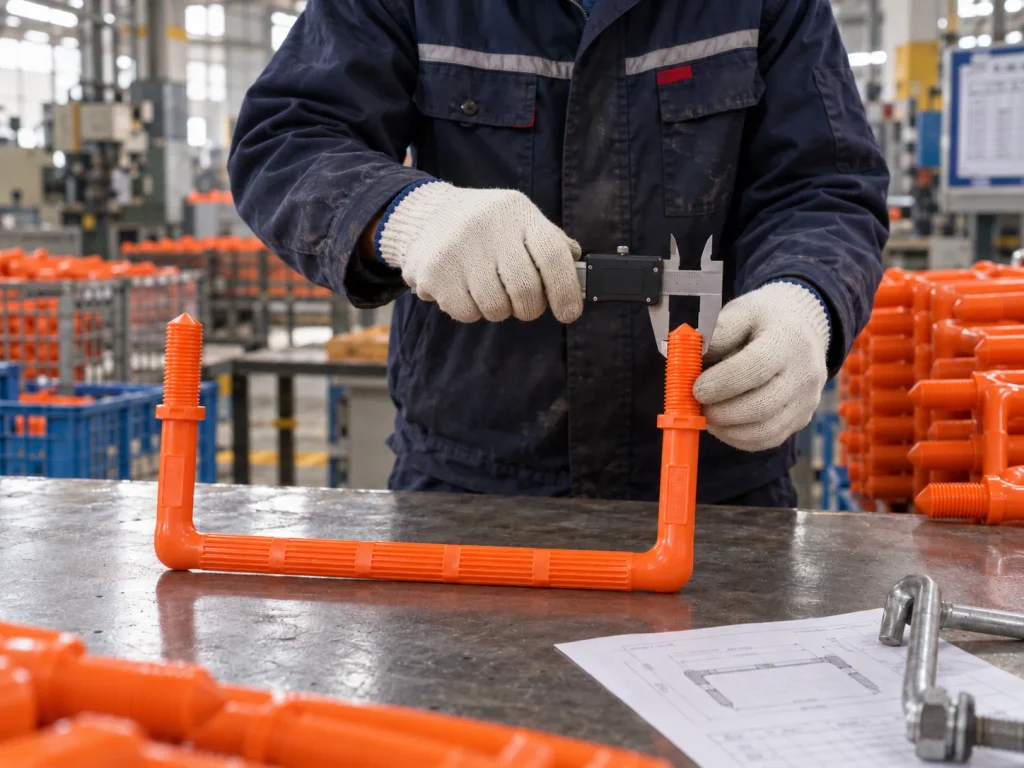
Expect more flexibility than a catalogue suggests, but less than “we can do anything”. Before a supplier gives you a price, they should be able to tell you which dimensions can change, what tooling that takes and how the sample gets approved.
Determine Which Specifications Can Be Customized
Common variables are geometry, width, core diameter, coating colour and texture, marking, packaging and hole spacing. Whether a change is realistic for your part should come out of a drawing review, not a sales email.
Be wary of the reverse, too. If a supplier quotes a new design with no tooling charge, ask why. Often they plan to use a tool they already have. That can be fine, but then the part follows their geometry, not your drawing, so check it against your mould before you approve.
Confirm Tooling, Sample Approval, and Drawing Review
The sequence usually runs like this:
- Drawing check: unclear dimensions are flagged, not guessed.
- Manufacturability review: anything that can’t be made as drawn gets raised now.
- Tooling plan: a new or adapted mould, if one is needed.
- Sample approval: fit, dimensions and finish checked, ideally in your own mould or wall.
- Batch release: production locked to the approved revision.
New tooling, extra processes and project-specific tests each add cost and time. Ask for them as separate lines on the quote, and ask who owns the tool once you’ve paid for it.
No complete drawing? That’s normal. Plenty of the custom inquiries we receive are one line long: “see drawing”, plus an attachment. For OEM manhole steps we can start from a sample, a sketch or a few key dimensions, and once the drawing is approved, any later change goes out as a new revision.
Compare MOQ, Lead Times, Packaging, and Total Purchase Cost
Compare total landed cost against a written delivery plan. The lowest unit price can still be the most expensive option once you add re-testing, rework or a missed pour date.
Evaluate Production and Delivery Reliability
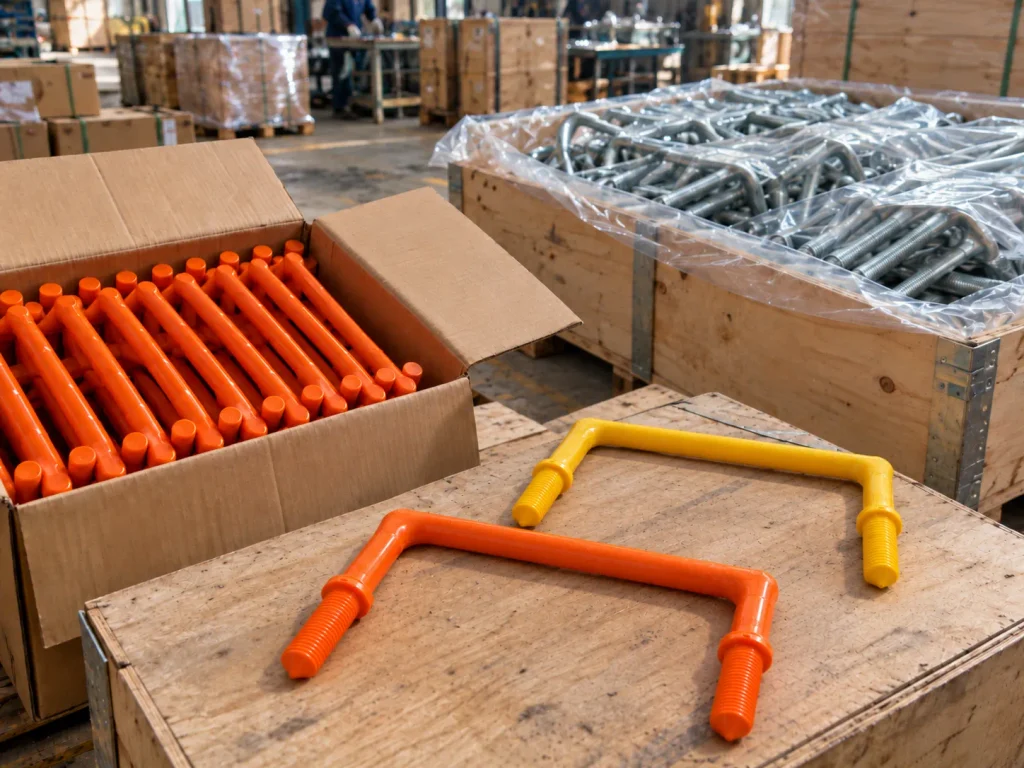
Get these in writing:
- MOQ for standard, OEM and new-tooling orders (they’re rarely the same)
- sample and tooling lead times, quoted separately from production
- realistic batch output and partial shipments, if your pour schedule needs them
- what a drawing change does to dates already agreed
Treat exact dates promised before the drawing is confirmed with caution. Across our custom metal parts, getting from first inquiry to a bulk order usually takes two to three months or more. That’s because nearly every buyer tests samples first, and some samples go round twice. If a supplier quotes much faster for a newly tooled part, ask them to walk you through the schedule.
Compare Total Landed Cost Instead of Unit Price Alone
Put every quote on the same basis before comparing. For a line-by-line approach, use our bulk manhole step quotation comparison guide.
| Cost item | Included? |
| Unit price per SKU | |
| Tooling / mould | |
| Samples and sample freight | |
| Project-specific testing | |
| Export packaging and pallets | |
| Freight and insurance | |
| Incoterm (FOB, CIF, DDP…) | |
| Allowance for rework or rejects |
State the Incoterm on every quote. A price per piece under FOB and one under DDP are very different numbers. For a supplier question list, see manhole step MOQ and lead time planning.
Use a Supplier Evaluation Checklist Before Placing a Bulk Order
Run the mandatory requirements as pass/fail first. Then score whoever is left, using only evidence they’ve actually sent you.
Score Suppliers Against Evidence, Not Promises
A high total can’t make up for a failed requirement. If the owner wants 316 stainless and a supplier only offers 304, that supplier is out, even if everything else looks good.
Evidence isn’t all equal, either. From strongest to weakest, roughly:
- your own test-fit of a production-tooled sample
- a third-party report naming your model
- the supplier’s in-house test record for your model
- a general certificate or a report for a similar model
- a sales promise
Score each criterion on the strongest evidence you hold, not on what the supplier says they could provide.
For repeat purchases, see our manhole step supplier audit checklist for distributors.
| Criterion | Example weight | Evidence to collect |
| Dimensional and technical fit | 30% | Drawing, tolerances, installation conditions, sample |
| Testing and quality records | 25% | Applicable standard, model-specific reports, batch traceability |
| Manufacturing and OEM capability | 20% | Available models, process, tooling and sample approval |
| Delivery and export readiness | 15% | Packaging plan, confirmed lead time, trade terms |
| Total purchase cost | 10% | Itemized quote, freight, packaging and extras |
These weights are an example, not an industry standard. If fit is already proven because you’re re-ordering an existing step, shift weight toward cost and delivery.
[Download the Manhole Step Supplier Evaluation Checklist →] (link once the PDF page is live)
Red Flags to Watch for When Evaluating Suppliers
- “We’ll match it” without asking for a drawing or sample
- No clear answer on how the step is made, or who does the coating
- Test reports that name a different model, or no model
- Lead times described as “fast” rather than as dates
- Claims to meet “all standards” before seeing your specification
- “Plastic-coated”, with no answer on whether it’s PP or PE
Any one of these might just mean a busy sales rep. Two or three together usually mean the evidence isn’t there.
Request a Technical Quotation for Your Manhole Step Project
Send the drawing, the specification and the quantity together, and write “unknown” for anything you don’t know. A blank gets filled with a supplier’s guess, and you won’t see which guess they made.
What to Include in Your RFQ
- country, project and owner
- application (sewer, stormwater, precast production, replacement)
- required material, or acceptable alternatives
- drawing or key dimensions, with revision
- estimated quantity: samples, first order, annual
- required standard and edition
- delivery timeline and destination
For a field-by-field version with a template you can paste into an email, see our manhole steps RFQ checklist.
What Happens After Submitting a Drawing
A careful supplier reviews the technical requirements first. Then they come back with a short list of questions before quoting. That’s normal for a part built to your drawing.
An instant price is fine for a standard catalogue step. For a step built to your drawing, it usually means the questions get asked later, after the money has moved.
Planning a bulk manhole step order? Send FERR your drawings, project requirements and estimated quantity. We’ll come back with what’s missing before we talk price.
FAQ
How can I verify the quality of a manhole step manufacturer?
Check evidence that’s tied to the model you’re buying. That means a test report naming the model and method, a dimensional check on the sample, material certificates with heat numbers, and a batch traceability record. Then test-fit a sample made on production tooling in your own mould or wall. Factory photos and general certificates are useful context, but they don’t prove your part is right.
What standards should manhole steps meet?
Whatever your project specification names, in the edition it names. EN 13101 is a product standard for steps and is common in Europe. In the US, ASTM C478/C478M covers precast manhole sections, including steps. In Australia, AS 4198 covers precast sewerage access chambers. Many utilities add their own requirements on top, so start from the tender documents.
Can manhole steps be customized for precast concrete projects?
Usually, yes. Width, projection, leg length, anchoring-end profile, colour and marking are the common changes. Whether a change is practical depends on your mould or insert system, the material, and whether it needs new tooling. Either way, approve a sample before bulk production starts, ideally one made on production tooling.
What information is needed for a bulk manhole step quotation?
Send a drawing or key dimensions, the material, quantity, destination, trade terms, required standard and target date. If you’re replacing an existing step, a sample or photos with a tape measure in shot help a lot. Marking unknowns as “unknown” saves a round of emails and stops suppliers quoting on hidden guesses.
What is the difference between PP-coated and galvanized manhole steps?
A PP-coated step wraps a steel core in polypropylene, so it’s protected as long as the coating stays intact. A galvanized step relies on a zinc layer bonded to the steel surface. Owners accept them in different chambers and exposure conditions, and their costs differ. Neither one is better everywhere, so check what your specification allows.