

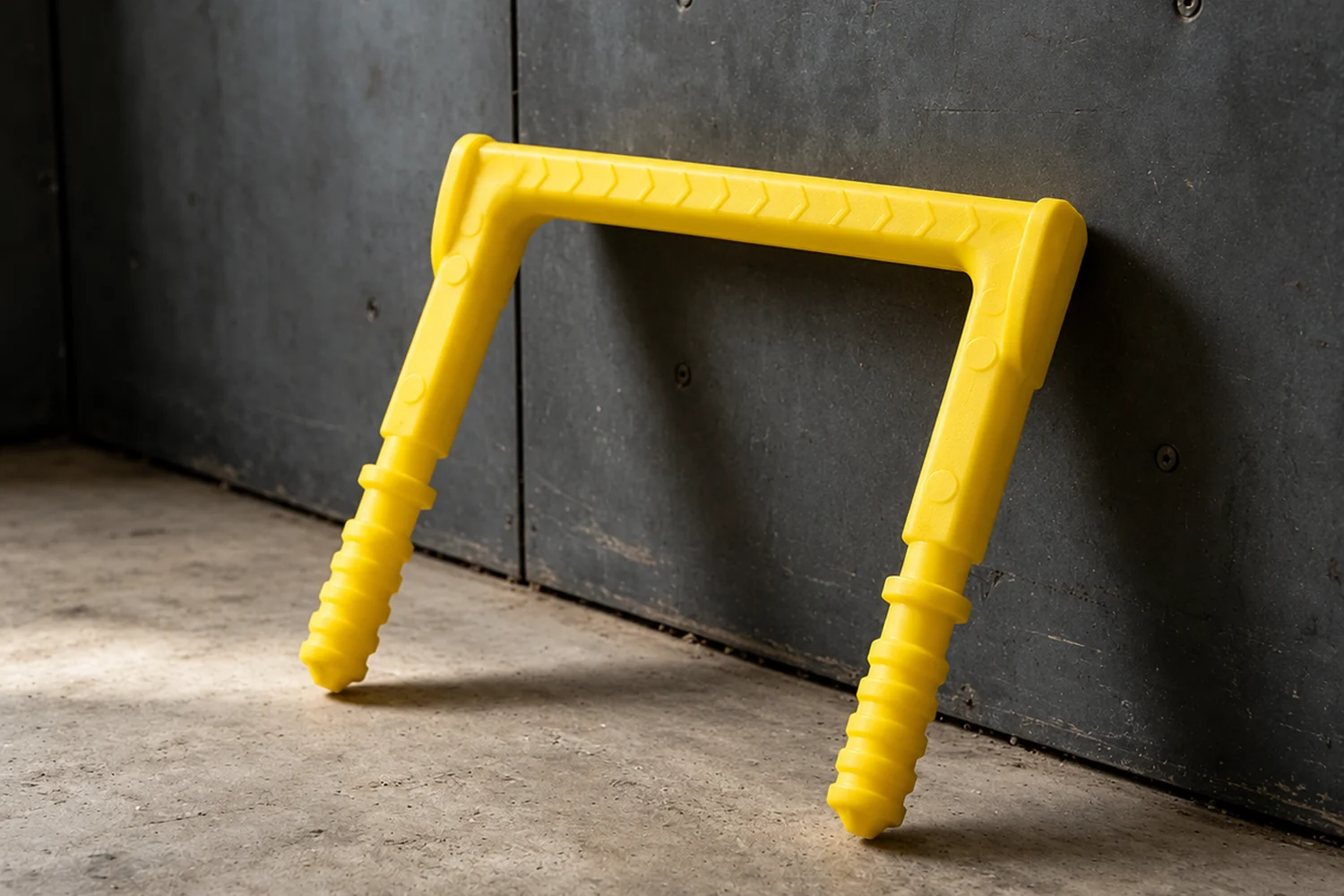
“Plastic doesn’t rust, so go PP-coated.” “Galvanized is cheaper, so use it wherever you can.” There’s some truth in both. Neither one settles anything until you know the chamber, the model and the test behind it.
A more useful way to see it: both step types protect the same steel, in opposite ways. A PP-coated step seals the steel off completely, and it’s fine until something breaks the seal. A galvanized step covers the steel in zinc that corrodes on purpose, slowly, so the steel underneath doesn’t.
So the real question is which failure your chamber is more likely to cause.
This guide compares the two on corrosion, load, installation, lifetime cost and the evidence to ask for. It’s written for teams buying in bulk, where one wrong assumption is repeated in every step in the container.
At a glance
| Comparison factor | PP-coated steel steps | Galvanized steel steps |
| Core structure | Steel core fully moulded inside polypropylene | Steel bar with an exposed zinc layer |
| Corrosion protection | Continuous plastic barrier keeps the environment away from the steel | Zinc acts as a barrier and corrodes sacrificially to protect small scratches |
| Slip resistance | Tread pattern and side boot stops can be moulded in | Depends on the tread: knurled, ribbed or plain bar |
| Typical surface risks | Splits, cracks, exposed steel at leg ends | Mechanical damage, zinc slowly used up |
| Customization issues | Core forming plus an injection mould for each new shape | Core forming plus galvanizing after fabrication |
| Main quality checks | Coating integrity, dimensions, load | Coating thickness, dimensions, load |
| Decision basis | Exposure, model and project test requirements | Exposure, model and project test requirements |
This table compares structure and protection mechanisms. It isn’t a performance ranking, and some steps are both: a galvanized core inside a plastic coating.
If you already know which type your project calls for, our custom manhole steps page covers the dimensions and fixing details we review against a drawing.
What Are Polypropylene-Coated and Galvanized Manhole Steps?
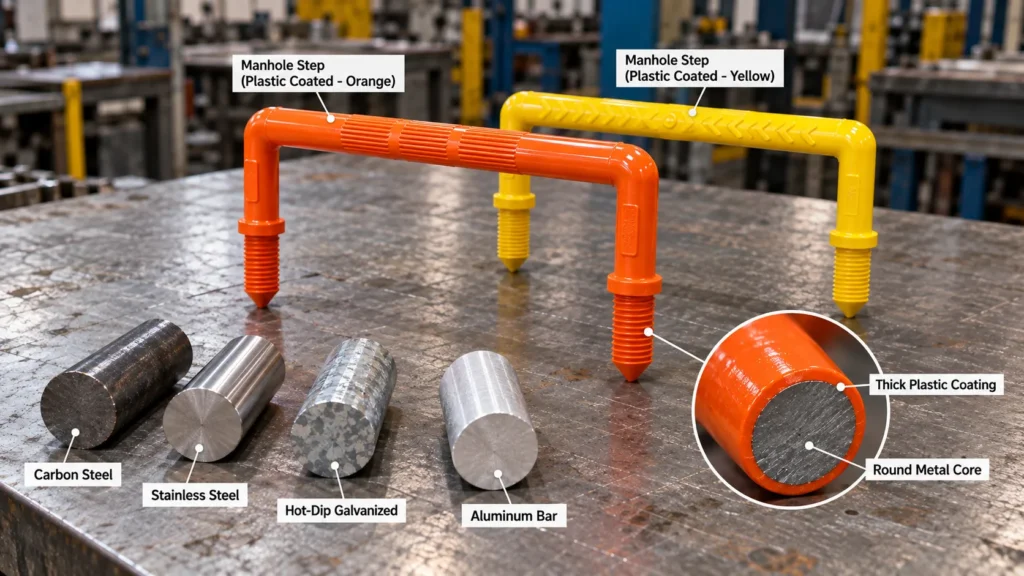
Both usually start as a bent steel bar, and in both the steel carries the load. A PP-coated step has that bar sealed inside moulded polypropylene. A galvanized step has zinc bonded directly to the bare steel. The difference is how the steel is kept from corroding.
How Polypropylene-Coated Steel Manhole Steps Are Made
The steel bar is cut and bent to shape, then placed in an injection mould, and polypropylene is moulded around it. Saint-Gobain PAM’s 330 mm PP step, for example, uses a 12 mm corrugated steel core in high-impact copolymer polypropylene. For a closer look at the core, resin and fixing ends, read what is inside a PP-coated manhole step.
The resin grade matters more than the word “polypropylene” suggests. Plain PP becomes brittle below 0 °C. Adding rubber (EPR or EPDM) improves its low-temperature impact strength, and PAM, for one, specifies a high-impact copolymer. If steps will be stored, handled or installed through a cold winter, ask which grade you’re getting.
How thick should the plastic be? The old UK water industry specification WIS 4-33-01 asks for the metal to be fully covered by at least 3 mm of polypropylene. It dates from 1990 and hasn’t been reviewed since, but it’s still a reasonable benchmark to ask a supplier about.
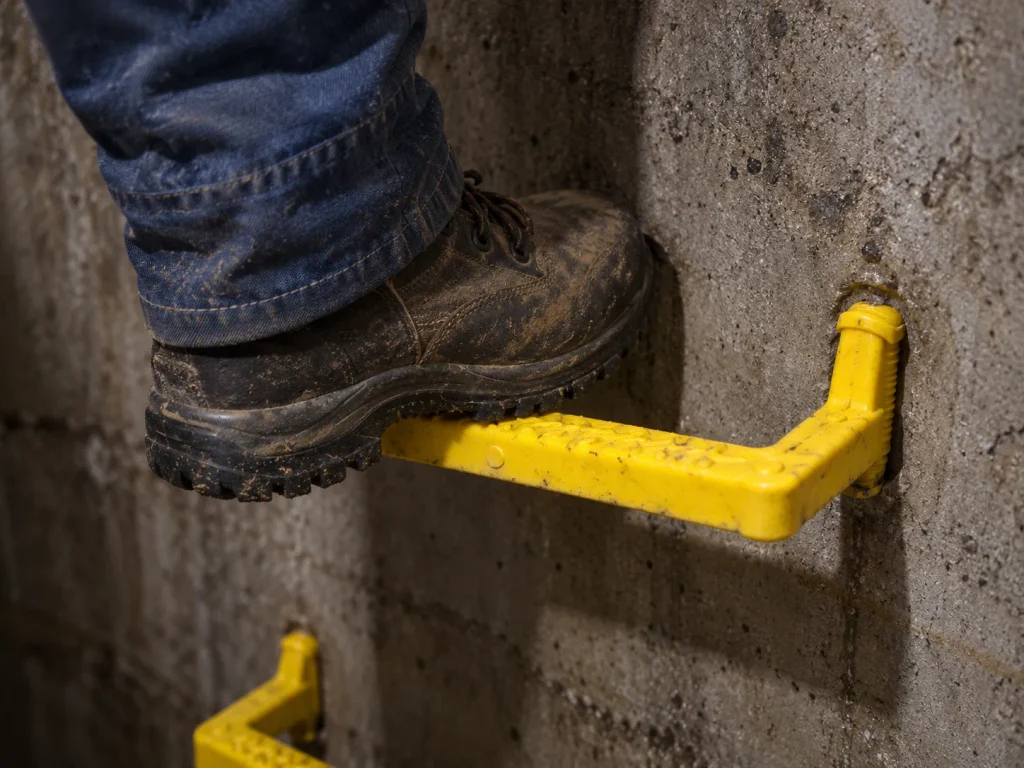
The mould also gives you things a bare bar can’t: a moulded anti-slip tread, side lugs that stop a boot sliding off the end, and colour. Yellow and orange are common.
How Galvanized Steel Manhole Steps Are Made
The bar is formed first: cut, bent and sometimes welded. Then it’s cleaned, fluxed and dipped in molten zinc. Galvanizing after fabrication like this is covered by ISO 1461 (AS/NZS 4680 in Australia and New Zealand), and it coats the cut ends and bends along with everything else.
Not all galvanizing works that way. Electro-galvanized parts carry a much thinner zinc layer. Bar that was galvanized before it was cut can leave the cut ends bare. From a photo you often can’t tell which process was used, so ask for the process and a coating thickness record. Don’t judge by how shiny the step looks.
Can a Manhole Step Be Both PP-Coated and Galvanized?
Yes, and some well-known steps are built that way. Hynds’ Pinnacle step in New Zealand puts a galvanized steel core inside a plastic coating. That coating is PE, by the way, not PP, which is why it’s worth confirming the resin before you accept “plastic-coated”.
The idea is a second line of defence: if the plastic is ever breached, the steel underneath still has zinc on it. Hynds sells it on exactly that point.
So this article compares two surface protection systems: a fully encapsulated metal core versus galvanized steel with the zinc exposed. It isn’t plastic against steel. And buyers don’t always pick one. One of our distributor customers in New Zealand has bought both types from us.
How Does Corrosion Resistance Compare?
While it’s intact, a PP coating keeps everything corrosive away from the steel. Zinc protects bare steel too, and it covers small scratches, but it gets used up as it does that, and much faster in acid. In aggressive sewer air an intact coating has the edge. Galvanizing copes better with small damage.
How PP Encapsulation Protects the Steel Core
The plastic is a barrier, nothing more. And it’s a good one in sewers: polypropylene doesn’t corrode the way metal does, and it’s routinely used to hold non-oxidizing acids. While the steel stays sealed inside, it stays dry.
The weak spots are wherever the seal can fail:
- Leg ends. On a bolt-through step the threaded end has to come out of the plastic to take a nut. Humes NZ has installers bury the end and nut in epoxy mortar, at least 10 mm deep. On other designs, ask exactly where the steel stops being covered.
- Thin spots. If the core sits off-centre in the mould, the plastic ends up thinner on one side. Cutting one sample open will show you.
- Impact damage. A split from installation or a dropped tool goes straight through the only barrier.
Now the uncomfortable part. Once water gets in at a breach, rust can creep along the bar under the plastic where nobody sees it. The coating keeps the step looking fine while the steel inside corrodes.
So “PP doesn’t rust” is true of the plastic, not of the step. The step’s life depends on resin grade, cover thickness, moulding quality and how the leg ends are sealed.
How Galvanizing Protects Steel Against Corrosion
Zinc does two jobs. It covers the steel like paint. And because zinc corrodes before steel does, it also protects small scratches and bare edges nearby, sacrificing itself as it goes.
How long that lasts depends on two things: how much zinc you start with and how fast your environment eats it. ISO 1461 sets the minimum thickness by section thickness. For steel over 6 mm thick, the minimum mean coating is 85 µm, and a step bar falls in that band. A thinner process won’t meet that figure, which is why “galvanized” on its own tells you very little.
Then there’s chemistry. According to the American Galvanizers Association, galvanized steel performs best between pH 5.5 and 12. Between pH 3 and 5.5 the coating still protects the steel, but only for a few years. Below pH 3 the AGA doesn’t recommend galvanized steel at all.
Which Performs Better in Sewer and Drainage Environments?
That pH range is the problem in many wastewater chambers. Where hydrogen sulfide builds up, bacteria on damp surfaces above the flow turn it into sulfuric acid. A 2017 review in Frontiers in Microbiology puts the surface pH of corroding sewer concrete at 2–4. The steps sit in that same damp air.
Not every sewer is that aggressive. But when one is, the zinc has a short life.
Stormwater is different, for a simple reason: the hydrogen sulfide comes from sewage, and a stormwater chamber normally doesn’t carry any. Without it, the acid problem mostly goes away and the chamber just wets and dries. That’s where galvanizing does well. Humes NZ’s own guidance follows the same split: stainless steel and plastic-encapsulated steps for wastewater, galvanized for stormwater.
| Exposure | Main risk | Evidence to request |
| Wastewater with H₂S | Acid attack on zinc; coating breach at leg ends | Coating thickness and integrity checks; how leg ends are sealed |
| Continuously damp chambers | Slow zinc loss; water creeping under a damaged coating | Galvanizing thickness record; resin grade and cover thickness |
| Coastal / salt air | Chlorides consume zinc faster | Project spec for the exposure class; whether stainless is required |
| Industrial drainage | Chemicals neither type may tolerate | Chemical resistance data for the actual medium and temperature |
| Stormwater | Mechanical damage more than chemistry | Coating thickness; dimensional fit |
Which Manhole Step Offers Better Safety and Load Performance?
The steel core decides how much load the step carries. The surface decides grip. A thick plastic shell doesn’t make a step stronger, so compare test results for the specific model, not material names.
Compare Slip Resistance and Tread Design
This is where PP has a real design advantage. The surface is moulded, so a tread pattern and side boot stops are built into the mould. Humes, for example, tells installers to fit its plastic-encapsulated steps with the anti-slip tread and boot stops facing up.
A galvanized step can have a knurled or ribbed tread too, but plenty are plain round bar. Ask which you’re getting.
Either way, a material isn’t “anti-slip”. A wet step coated in sewer slime is slippery whatever it’s made of. Judge grip by the tread design and, if your spec requires one, a slip test on that model.
Understand Load Capacity and Steel Core Strength
Load performance comes from the core grade and diameter, the step’s shape, leg length, the anchoring end and the concrete it’s set into. The plastic adds very little, because steel is well over 100 times stiffer than polypropylene.
A PP step can look chunky around a modest core (PAM’s uses 12 mm). A galvanized step shows you its bar, but a thick bar isn’t proof either. Neither replaces a load report.
What Test Results Should Buyers Request?
Depending on your specification, expect some combination of:
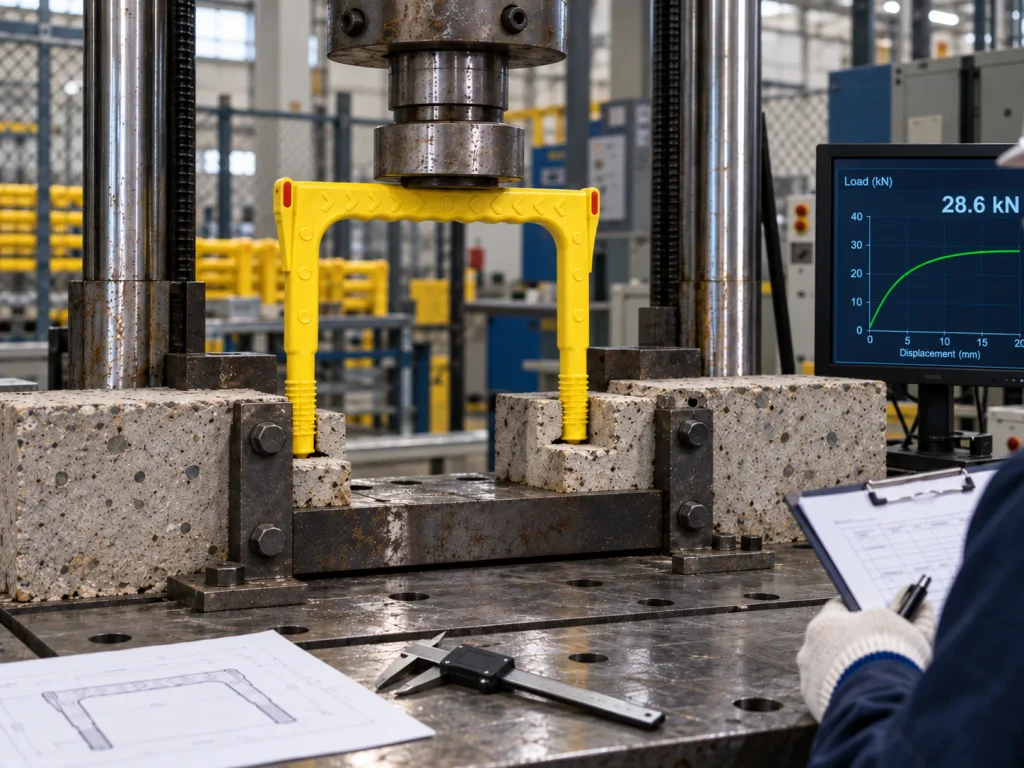
- vertical load: deflection under load, and permanent deflection once it’s removed
- pull-out: the force needed to pull the step from its fixing
- torsion or twisting of the tread
- impact
To see what a complete set of results looks like, PAM publishes EN 13101 results for its PP step: deflection of 10 mm or less under 2 kN with no more than 2 mm permanent, a minimum 5 kN pull-out, and a 20 kg mass dropped from 1 m. Those are one manufacturer’s results, not your project’s acceptance criteria. Check the standard edition and class your specification names.
Then check the report itself. It should name the model, the test method and standard edition, the date, the lab, and how the sample was installed for the test. To verify a supplier’s evidence, follow our manhole step manufacturer selection guide.
How Do Installation and Maintenance Requirements Differ?
Fit depends on dimensions and fixing method, not material. Each type does have one installation weak point, though. A PP step’s coating can split when it’s driven in. A galvanized step’s zinc gets damaged when it’s cut, drilled or welded on site.
Compare Anchoring Methods and Installation Dimensions
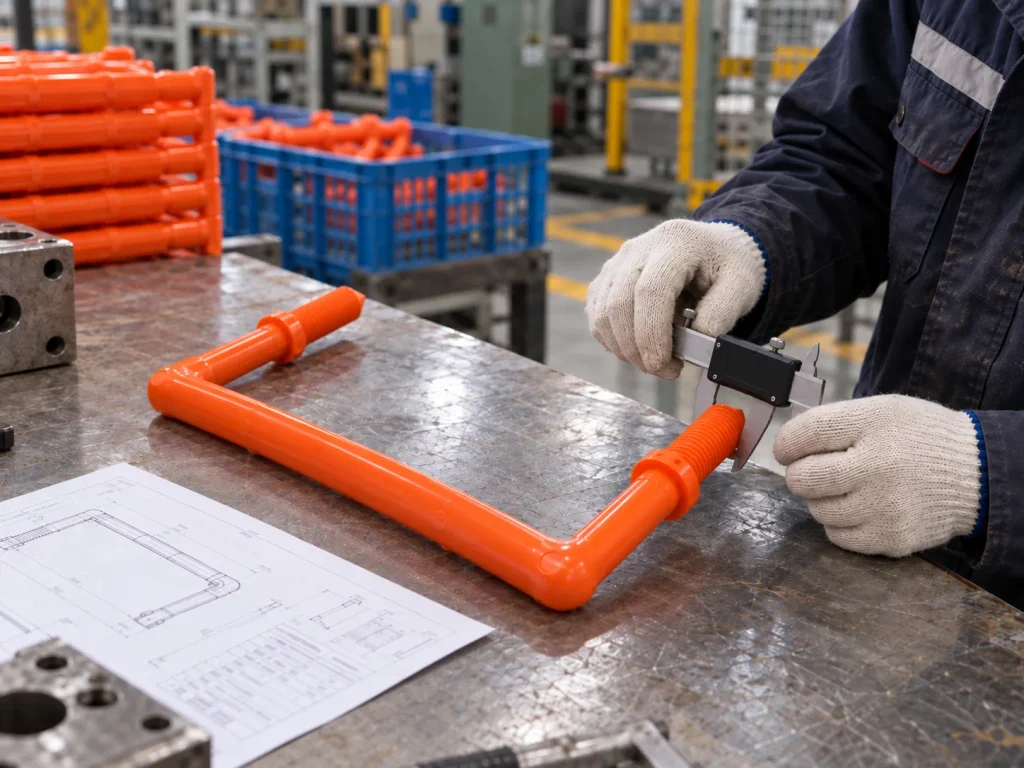
These are the dimensions that decide whether a step goes in:
- hole centre distance
- insertion depth
- hole diameter
- step projection from the wall
- anchoring end design
The fixing method changes which ones matter. Steps can be cast in at the precast plant, pushed into inserts cast into the wall (Hynds’ system works this way), driven into drilled holes, or bolted through the wall. PAM’s drilled-in step, for instance, goes into two 25 mm holes drilled after the concrete has hardened, at 85 or 105 mm deep depending on the model. Humes’ bolt-through step uses a rubber gasket, washer and nut on the outside, sealed with epoxy mortar.
Each method needs its own leg design, so an installation sheet from a step that only looks similar isn’t good enough. If you’re matching an existing mould or wall, our manhole step customization page lists the dimensions we usually check.
How Can Surface Damage Affect Long-Term Performance?
For a PP step, installation day is one of the riskiest moments. Humes’ installation guide warns: “DO NOT hammer the Step in the centre.” Tap alternate legs instead. A split made then is a hole in the only barrier, and there’s no practical way to re-encapsulate a step that’s already in the wall. Usually it gets replaced.
Galvanized steps are more forgiving. The 2022 revision of ISO 1461 expanded its guidance on repairing damaged areas, including zinc-rich paints. A touch-up beats bare steel, but don’t expect it to last as long as the original coating, especially in an acidic chamber.
Both have the same rule: anything drilled, cut or welded after coating needs a written repair method, agreed before it happens.
What Should Maintenance Teams Inspect?
- steps that move, rock or have loosened in the wall
- bent or deformed treads
- splits or cracks in the coating, especially at bends and where the legs enter the wall
- rust staining coming from under a coating, or red rust through zinc
- cracked or missing mortar around the legs
How often to check is set by the asset owner’s maintenance schedule and confined-space procedures. It’s not something a step supplier should decide for you.
Which Type Is Better for Different Applications?
Start from the chamber, not the material. Encapsulated (or stainless) steps are a common choice for wastewater and galvanized steps for stormwater, but owner specifications differ, so the project document decides.
Manhole Steps for Wastewater and Sewer Projects
If we had to pick blind for a wastewater chamber, we’d lean toward encapsulated. You shouldn’t pick blind, though.
The questions that matter: does the chamber see hydrogen sulfide? How are the leg ends sealed? And which load, pull-out and coating tests does the owner require? A well-encapsulated step with unsealed leg ends can do worse than you’d expect.
Manhole Steps for Stormwater and Precast Concrete Systems
For a precast plant, fit comes before chemistry: the step has to suit the mould, the insert or hole spacing and the way the plant casts it in. Both types can work in stormwater chambers, so the owner’s approved list and your production setup usually decide.
Material Selection for Coastal and Industrial Environments
Salt air, heat and process chemicals are where general rules stop helping. Chlorides use up zinc faster. Some industrial media will attack plastics as well.
Some owners skip both options. Kāpiti Coast District Council’s standard drawing CM-004 in New Zealand calls for 20 mm grade 316 stainless steel step irons “or approved alternative”. Without exposure data and the project spec, nobody should tell you one type is “best” here, including us.
| Scenario | Prioritize | First-pass judgement |
| Sewage manholes | Sewer conditions, coating integrity, tests | Evaluate encapsulated first, then verify the model |
| Stormwater chambers | Water quality, anchoring dimensions, project requirements | Either type can work; check exposure and installation |
| Precast concrete | Casting-in process, hole spacing, fit | Match the plant’s existing process first |
| Coastal infrastructure | Salt spray, humidity, corrosion requirements | Assess material and coating suitability; stainless may be specified |
| Industrial drainage | Medium, temperature, special specs | Verify against the actual operating conditions |
How Do Initial Cost and Lifecycle Cost Compare?
The cost of replacing a step that has failed in a live chamber can be far higher than the step itself. So weigh unit price against how long that step will last in that particular chamber.
What Affects the Initial Purchase Price?
The main factors are core steel grade and diameter, resin type and quantity, injection tooling (a new size usually means a new mould), galvanizing (often charged by weight), testing, and packaging. Volume changes all of these, so does a custom geometry.
We’re not going to give you an “average price”. Without a spec and quantity it wouldn’t mean anything. For a practical quote-by-quote comparison, read our bulk manhole step pricing guide.
Why Should Buyers Consider Replacement and Maintenance Costs?
A step is cheap. Replacing one isn’t: confined-space entry, traffic management, a crew’s day and drilling out the old fixing. If a cheaper step has to be replaced sooner in an aggressive chamber, the saving is gone. In a benign stormwater pit, the same step may last the full design life. Compare against your design life and your exposure, not a general rule.
What Standards and Quality Tests Should Buyers Check?
EN 13101 covers the step as a product. ISO 1461 covers only the zinc coating. A galvanizing certificate says nothing about load or pull-out, so where your spec calls for both, ask for evidence of both, tied to the model you’re buying.
EN 13101 Requirements for Manhole Steps
EN 13101 covers steps for underground man-entry chambers: requirements, marking, testing and evaluation of conformity. It applies whatever the material, plastic-coated and galvanized steps alike.
Projects often name a type or class within the standard, and sometimes an edition. Check both. Outside Europe you’ll also see chamber standards that cover steps, such as AS 4198:2022 in Australia and ASTM C478/C478M in the US, plus utilities’ own specifications, which often have the final say.
[Technical reviewer: confirm the edition and scope cited before publishing.]
Galvanizing Requirements Under ISO 1461
ISO 1461 covers hot-dip galvanized coatings on fabricated iron and steel articles. It sets minimum thickness by section thickness, plus appearance and inspection sampling. The 2022 revision added rules for low-reactivity steels and expanded the guidance on repairs.
It’s a coating standard. A step can carry a perfect ISO 1461 coating and still fail a pull-out test because the leg design is wrong.
What Documents Should a Manufacturer Provide?
- an engineering drawing with dimensions and tolerances, by model
- material specs for the core, plus the resin grade or galvanizing spec
- test reports that name the model tested
- coating records: thickness for galvanizing, integrity checks for encapsulation
- batch inspection records, installation instructions, and packaging labels you can trace back
We check core material, surface treatment and coating against the approved specification for every production order. You can see how we inspect and record custom parts on our quality assurance page. Ask any supplier, us included, which of the documents above they can produce for your model today and which would need new testing.
How Should Buyers Choose Between PP-Coated and Galvanized Manhole Steps?
Let the chamber narrow the choice, let the specification confirm it, and let model-specific evidence close it. Work through the questions below in order, and the choice usually narrows to one type fairly quickly.
A Practical Material Selection Checklist
- Application. Wastewater, stormwater, precast production, or replacement?
- Corrosive conditions. Hydrogen sulfide, chlorides, chemicals? Is there any pH data?
- Temperature. Cold winters (ask for the PP grade) or warm process effluent?
- Protection system. Encapsulated (which resin, what cover thickness, how are the leg ends sealed?), galvanized (which process, what thickness?), or both?
- Dimensions and installation. Hole centres, insertion depth, projection, anchoring end and fixing method.
- Load and tests. Which standard, which edition, which class, which tests?
- Quantity. Samples, first order, annual volume.
- Project specification. Owner, document and approved-product list.
If you can’t answer something, write “unknown”. That’s more useful to a supplier than a guess. After confirming the material, prepare the enquiry using our manhole steps RFQ checklist.
When Should Buyers Request a Custom Design?
A standard model is fine when it fits your hole centres, fixing, material and test requirements. You need a custom design when any of those don’t match: an existing wall with odd spacing, a mould insert from another system, a core or coating your spec requires, or a test your standard model hasn’t passed.
In that case, send the drawing and the application conditions. A technical review should come before any decision to make a new mould or start production. Our drawing review and sampling process shows where tooling decisions fit in.
Request the Right Manhole Step for Your Project
Choosing between PP-coated and galvanized manhole steps for a bulk project? Share your drawings, application conditions, required standards and estimated order quantity with FERR. Our team can review your specifications and discuss suitable manufacturing options.
If the chamber, the spec and the evidence point to galvanized, we’ll say so, even if you came in asking about PP.
Send your drawing for a manhole step review →
No complete drawing yet? A sample, a sketch or a few key dimensions is enough to start.
Further reading: How to Choose a Manhole Step Manufacturer for Bulk Projects
FAQ
Are polypropylene-coated manhole steps more corrosion-resistant than galvanized steps?
In acidic, H₂S-affected sewer air, an intact PP coating usually protects the steel better than zinc does, because galvanizing wears quickly below about pH 5.5. The word that matters is intact. A split coating or an unsealed leg end lets corrosion start where you can’t see it. In near-neutral stormwater, well-galvanized steel can perform just as well.
Can galvanized steel manhole steps be used in sewer systems?
Sometimes. It depends on how aggressive the sewer is and what the owner allows. Where hydrogen sulfide makes surfaces acidic, zinc is used up much faster, which is why some suppliers and owners steer wastewater chambers toward encapsulated or stainless steps. Check the project specification and the approved-product list before choosing galvanized for any sewer job.
Do PP-coated manhole steps always have a galvanized steel core?
No. Hynds’ Pinnacle step uses a galvanized core for a second layer of protection, but many datasheets, PAM’s for example, just say “steel core”. If the quote doesn’t state the core material and finish, ask. If it only says “plastic-coated”, ask which resin too, because some well-known steps are PE-coated, not PP.
What standards apply to polypropylene-coated and galvanized manhole steps?
EN 13101 is the product standard for the step itself and applies to both types. ISO 1461 (AS/NZS 4680 in Australia and New Zealand) covers only the hot-dip zinc coating. Many projects also cite chamber standards such as AS 4198 or ASTM C478 and the owner’s own specification, so start from the tender documents, not the supplier’s brochure.
Which manhole step material is better for bulk infrastructure projects?
Neither wins everywhere. A bulk order repeats one decision thousands of times, so match the material to each chamber type rather than standardising for convenience. Plenty of buyers split the order: encapsulated for wastewater and galvanized for stormwater. Then approve a sample of each model against your fit and test requirements before production.