

Email five factories “please quote manhole steps, 5,000 pcs” and you’ll get five prices back. Very likely for five different steps.
One priced a thinner core bar. One assumed galvanized, another assumed PP. Nobody asked about your hole centres. The cheapest quote looks great until the samples arrive and the legs don’t line up with the holes in your mould.
Those quotes aren’t wrong. Each supplier filled your gaps with its own assumptions, and the assumptions are where the price differences come from.
So an RFQ isn’t really a request for a price. It describes the part tightly enough that every supplier prices the same thing, and anything you can’t pin down, you make them state. Below are the 12 details that do that, why each one moves the price or the fit, and a template you can paste straight into your next email.
The 12 details at a glance
Every detail on the list is there for one of three reasons: it changes the price, it decides whether the step fits, or it decides whether the owner accepts it. That’s also how to tell what you can leave out for now.
| No. | What to send | What it changes | Needed for a ballpark? |
| 01 | Application and end-use country | Which checks and specs apply | Sí |
| 02 | Step type and a reference | Which product gets quoted | Sí |
| 03 | Core material and grade | Material cost, strength | Sí |
| 04 | Coating or encapsulation, and colour | Process and cost | Sí |
| 05 | Dimensions, drawing and tolerances | Fit, tooling | Key dimensions |
| 06 | Mounting method and wall interface | Fit | No |
| 07 | Standard, edition and tests | Acceptance, testing cost | No |
| 08 | Quality documents and inspection | Acceptance, inspection cost | No |
| 09 | OEM design, tooling and marking | Tooling cost | If it’s custom |
| 10 | Quantity per size and forecast | Unit price | Sí |
| 11 | Packaging, labels and export documents | Packing cost, freight volume | No |
| 12 | Destination, Incoterms, payment, deadline | Freight, risk | Sí |
A ballpark price, for a budget or a first shortlist, needs the rows marked yes. A quote you can actually compare and sign needs all twelve, because every row moves either the price or the acceptance.
If you don’t know something, write “unknown”. A supplier can work with “unknown”. A blank looks like you forgot, and they’ll fill it with a guess you can’t see.
What should each detail say?
What is the step for, and where will it be installed?
Name the structure and the country of end use: sewer manhole, stormwater pit, precast chamber, cable pit. And say whether it’s a new build or replacement steps for chambers already in the ground.
That last part changes more than people expect. On a new precast job, the step and the mould can still be adjusted to each other. On a replacement job the holes are already in the wall, so the leg spacing and hole size are fixed and the step has to match them exactly.
In our own custom-part inquiries, this is the field most often missing: a drawing, “please quote”, and no word on where the part goes. A supplier who knows the application can flag a problem early, like a coating your owner doesn’t accept in sewers, instead of quietly quoting it.
The country hints at which standards apply, but don’t let a supplier guess your certification from it. That’s detail 07.
What type of step, and do you have a reference?
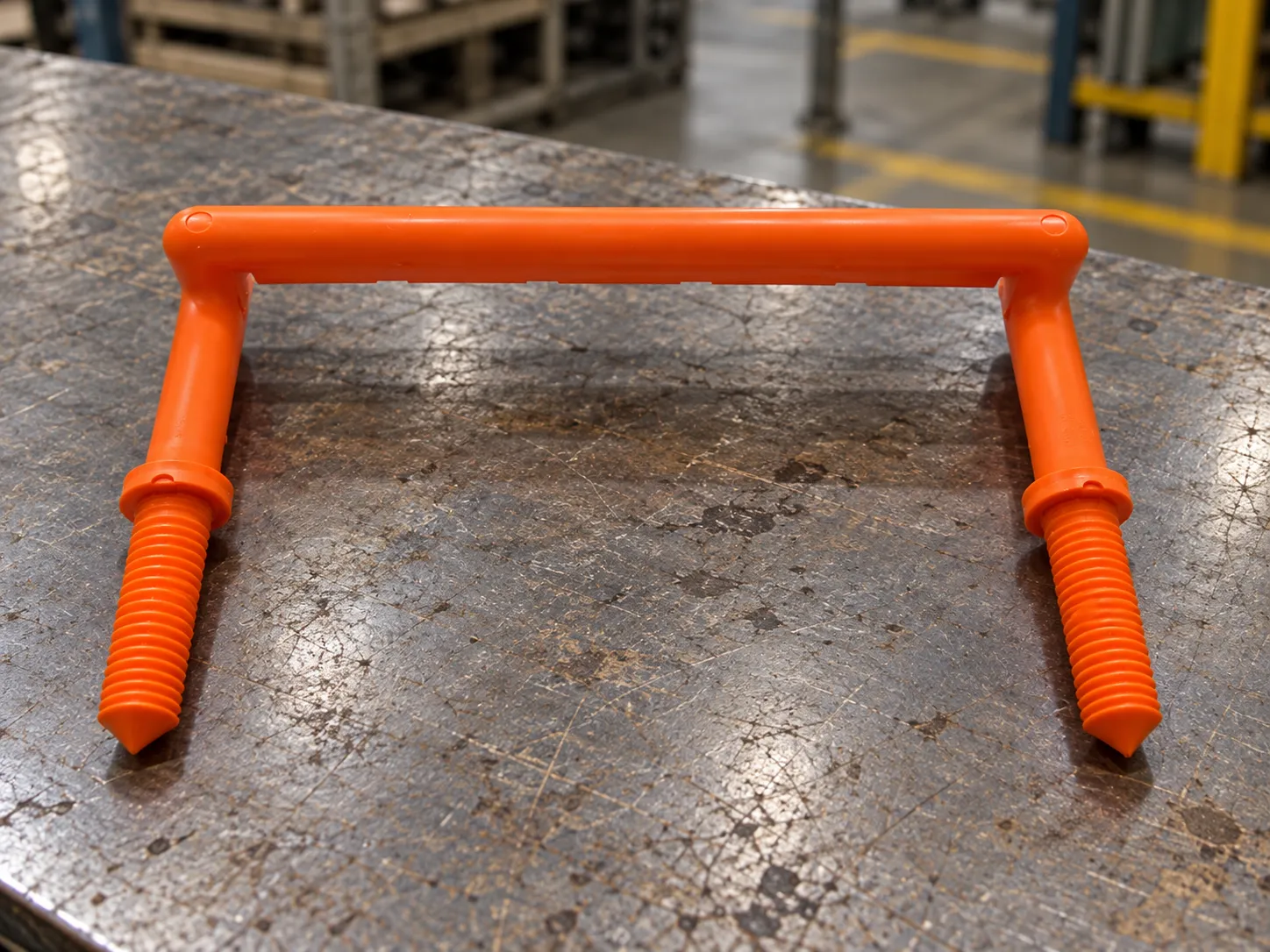
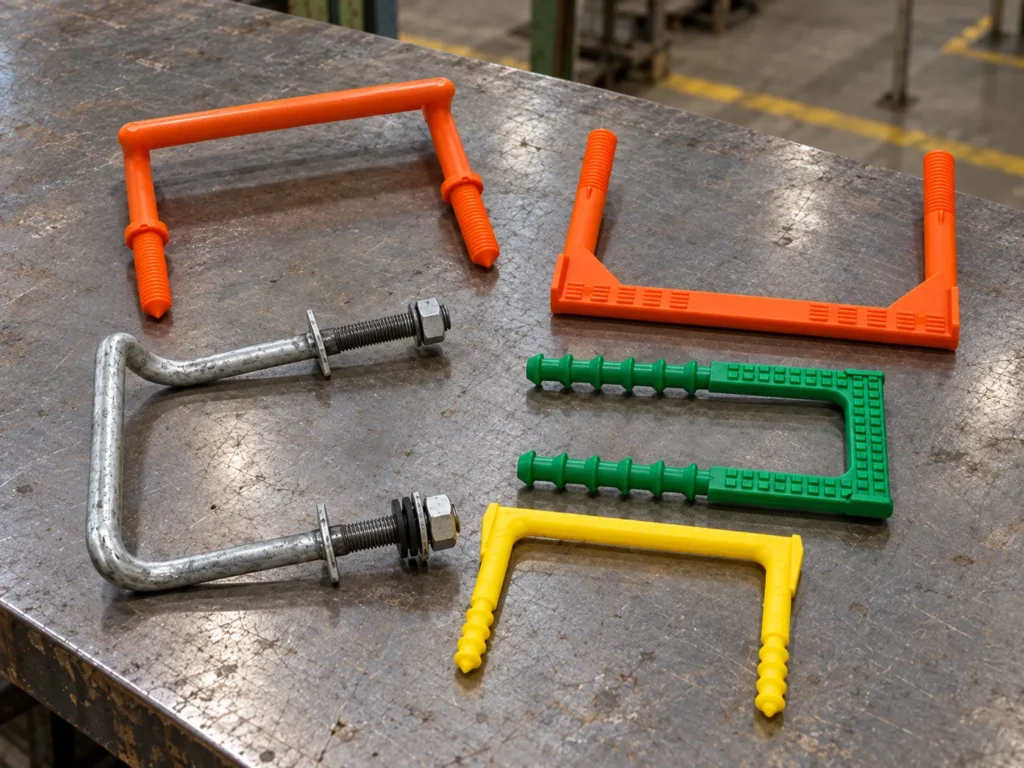
The most common form is a U-shaped rung with two legs. If yours is anything else, say so up front. A reference is worth more than a paragraph of description, so attach a photo, a competitor’s model number or a physical sample. If you send photos, put a tape measure in the shot.
And be clear you’re buying individual steps, not a fixed ladder.
What is the core made of?
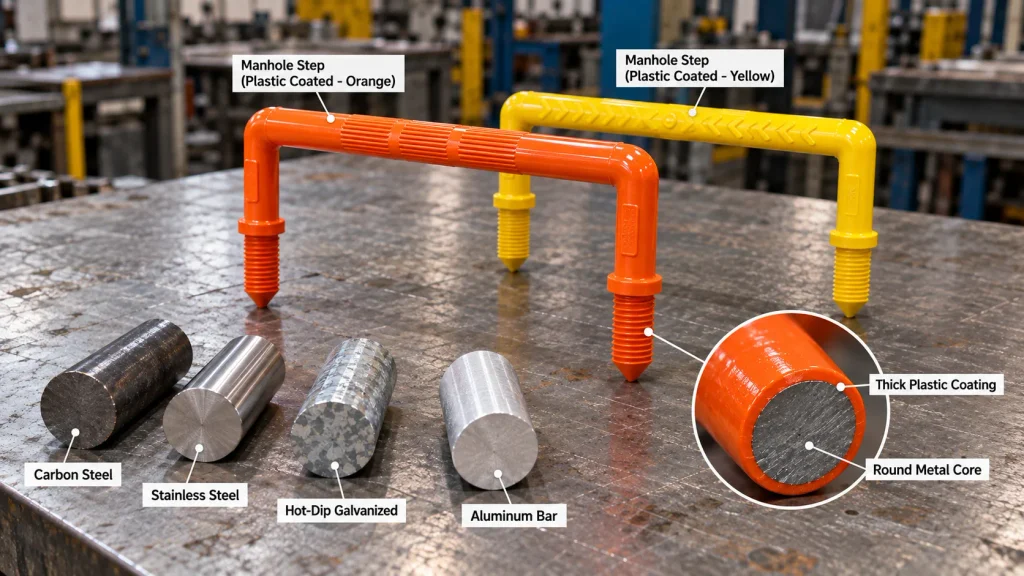
“PP manhole step” describes the coating, not the step. There’s a metal bar inside the plastic, and that bar carries the load.
So name the core: carbon steel bar, stainless steel, or cast or ductile iron for cast designs. If your specification names a grade, copy it exactly. If it doesn’t, say so and ask the supplier to propose one with the certificate to back it up.
How is the core protected, and what colour?
Say which protection you want: polypropylene encapsulation, hot-dip galvanizing, another coating, or bare stainless. If it’s plastic, name the plastic. “Plastic-coated” can mean PP or PE, both are sold as manhole steps, and specs don’t always accept both. To verify what a PP-coated step contains, read our breakdown of the steel core and polymer layer.
Colour is mainly for visibility. Orange, yellow and black are all common, but colour doesn’t tell you anything about durability or compliance. If you need a textured anti-slip tread, ask for it here. Same if the step goes into a corrosive environment, like an aggressive sewer atmosphere or salt air near the coast.
Which dimensions, measured from where?
This is the detail that decides fit, so it gets the most space here.
Send these, with units:
- clear tread width (the usable width your boot stands on)
- overall outside width
- centre-to-centre distance between the legs, or between the holes
- projection from the wall
- leg length / embedment depth
- core bar diameter
- the shape of the anchoring end
- tolerances for each
Then say what each number is measured from. Tread width, outside width and leg centre distance are three different numbers, and on a PP step, measuring over the plastic gives a different answer from measuring the steel core. If your drawing is in inches, leave it in inches and say so. Converting adds rounding errors.
If your drawing has no tolerances, mark which dimensions are critical, usually the leg centres and the anchoring end. Tight tolerances on every dimension cost money and don’t make the step fit any better.
Why so fussy? When we’ve had to redo custom parts, the metal was rarely the problem. Usually the dimensions we’d been given didn’t quite match the buyer’s equipment. With a manhole step, the “equipment” is your mould or your wall.
A PDF drawing is fine. A STEP file helps for new designs. A dimensioned hand sketch is enough for a first look. Whatever you send, put a revision letter on it.
How does the step go into the wall?
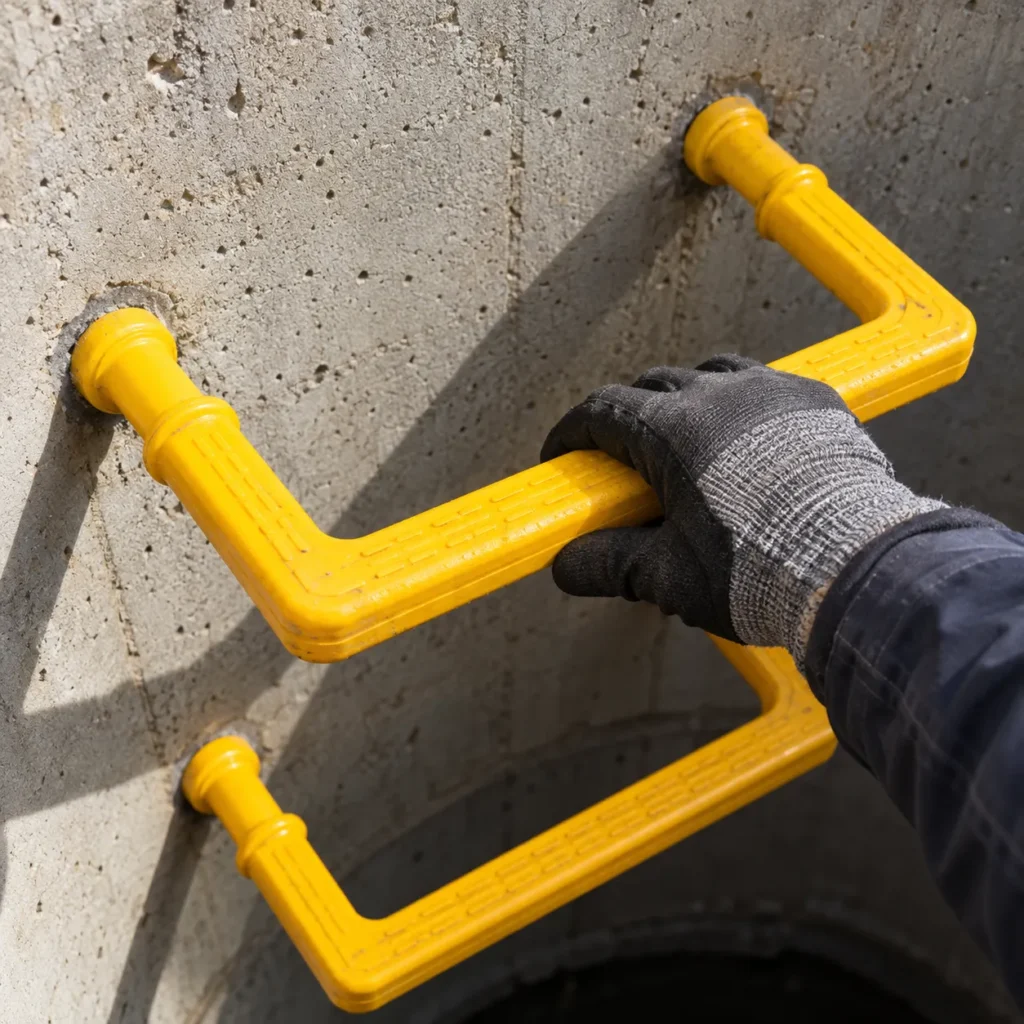
There are three common ways. The step can be cast in at the precast plant, driven into preformed holes, or drilled and fixed on site, often with resin or grout. Tell the supplier which one, plus the hole diameter, depth and spacing, and the wall material and thickness.
Installation instructions for one model don’t carry over to another, even if the two look alike. Ask the supplier to check their step against your hole size and wall thickness in writing, then test-fit the sample in a real wall or mould before you approve it.
Which standard, which edition, which tests?
Give the standard number and edition your project requires, the tests you need, and how the results will be accepted.
The usual suspects:
- EN 13101 for steps in underground man-entry chambers, used across Europe.
- ASTM C478/C478M in the US. This covers precast manhole sections, with steps and ladders as one section of it, so it isn’t a stand-alone step certificate.
- AS 4198 in Australia. Like C478, it’s a standard for the precast access chamber, not for the step itself.
- On top of any of these, the owner’s or utility’s own specification. In practice that’s often the document that decides.
“EN-certified” with no edition and no evidence requirement isn’t something a supplier can price. Say which tests apply (vertical load, pull-out, impact, coating integrity, or whatever your spec lists). Say whether you’ll accept in-house results or need a third-party lab, and whether the report is due before sample approval or before shipment. Third-party testing costs time and money. You want it in every quote, not added later.
One trap: don’t borrow load classes like D400 from EN 124. That standard covers manhole covers and gully gratings, not steps.
What paperwork and inspection will you need?
List what you’ll want at delivery: material certificates, a dimensional report on the first article, test reports, batch traceability, and any pre-shipment inspection by you or a third party.
You can leave this out of a ballpark request, but not out of the RFQ you’ll compare. Third-party inspection and reports cost money, and if you ask for documents after the price is agreed, they turn into a negotiation. And keep two things apart: what you require, and what the supplier says they can provide. They’re not always the same list. (Here’s how FERR inspects and records custom parts, if you want a comparison point.)
Is it a stock design or your own?
Say whether you’re buying an existing design or an OEM one: your dimensions, your logo, your tread pattern.
New geometry usually means new tooling, either an injection mould for a PP step or a pattern for a cast one. Ask for tooling as a separate line. Also ask who owns the tool once it’s paid for, and whether any of the cost comes back after a set volume.
On custom projects, tooling cost is one of the most common reasons we see a buyer, or their end customer, put a project on hold after the first quote. Better to see that number early. And if a new design comes back with “no tooling charge”, ask why. Often the supplier plans to use a tool they already have. That can be fine, but it means their geometry, not yours, so check it against your drawing.
If you’re not sure what’s involved, our drawing review and sampling process shows the steps between your drawing and an approved sample.
How many, of which size?
Give a quantity for each size, the first order versus annual volume, any call-offs, and how many samples you want.
“Bulk” isn’t a number. The most common reason we can’t quote a custom inquiry at all is that the quantity is missing, or too small to cover the setup. Tooling and setup get spread across the pieces, so the same step can carry a very different unit price at 500 and at 5,000. A rough range is far better than nothing.
Still deciding which sizes to standardise on? Our manhole step manufacturing options page lists the dimensions we usually adjust for precast and replacement projects.
How should it be packed and labelled?
Pieces per carton, pallets or not, shipping marks, barcodes, label language, and any documents customs or your client will ask for, such as a certificate of origin. If you use wooden pallets, they’ll need ISPM 15 treatment for most export destinations.
Don’t treat another supplier’s pack count as standard. Ask for it.
RFQ line: Cartons on ISPM 15 export pallets. Shipping marks and barcode labels per attached file. Certificate of origin required.
Where to, on what terms, and by when?
Give the destination port or city, the Incoterm (with edition, usually Incoterms 2020), the payment terms you expect, your target delivery date, whether you need partial shipments, the date you need quotes back, and how long they should stay valid.
A FOB price and a DDP price aren’t the same number, and a 30% deposit isn’t the same deal as paying 100% up front. If you’re comparing suppliers, ask everyone for the same terms. Asking for two Incoterms (FOB and CIF, say) shows you where the freight sits.
A copy-and-paste manhole steps RFQ template
Fill in what you know, write “unknown” for the rest, and attach what you have. Don’t skip the three requests at the end. Itemised lines let you compare quotes line by line, and the list of assumptions shows exactly where two suppliers priced different steps.
Subject: Manhole Steps RFQ – [Project / Country] – [Estimated Quantity]
Hello,
We’d like a quotation for manhole steps. Please review the details below
and confirm technical compatibility, available options, MOQ, lead time
and pricing.
1. Application and end-use country: [ ]
2. Step type / reference model / photos: [ ]
3. Core material and grade: [ ]
4. Coating / PP encapsulation / colour: [ ]
5. Dimensions, tolerances and drawing revision: [ ]
6. Mounting method, hole size and wall details: [ ]
7. Standard, edition and required tests: [ ]
8. Documents and inspection required: [ ]
9. OEM design / tooling / logo or marking: [ ]
10. Quantity per SKU, first order and forecast: [ ]
11. Packaging, labels and export documents: [ ]
12. Destination, Incoterms, payment terms, delivery date and
quote deadline: [ ]
Attachments: [drawing] [reference photos] [project specification]
In your offer, please:
– quote unit price per SKU, tooling, samples, testing, packaging
and freight as separate lines
– list any assumptions you made where we wrote “unknown”
– list any deviations from our specification
Best regards,
[Name / Company / Contact]
What mistakes hold up a bulk quote?
Each of these can undo an otherwise careful RFQ.
“Standard size.” There’s no single standard manhole step. Name the model or send the dimensions.
Sending different suppliers different information. One gets drawing rev. A, another gets rev. B plus a phone call. Send everyone the same email, the same attachments and the same deadline, or the quotes can’t be compared.
Changing the spec after quotes come in. If you switch the coating or the quantity, re-issue the change to every supplier, not just your favourite. Otherwise you’re comparing the new spec against the old one. Once all suppliers quote the same revision, use this bulk manhole step quote comparison guide.
Buying for a client without saying so. Say who decides and roughly when. Projects that wait on an end customer’s sign-off tend to stall between sample and order. A supplier who knows the timeline can plan around it.
Preguntas frecuentes
Can I request a manhole step quote without a drawing?
Yes. Clear photos with a tape measure in shot, a reference model number and the key dimensions (leg centres, tread width, projection, leg length, core diameter) are enough for a first price. Before production, the supplier should turn that into a drawing for you to approve. Don’t let production start until you’ve signed it.
Which dimensions matter most in a manhole step RFQ?
Leg centre distance, leg length or embedment, projection, core diameter, and the hole diameter and depth. Those decide whether the step goes into your wall. Tread width matters to whoever climbs it, but it’s rarely why a step doesn’t fit.
Do I need to specify EN 13101 or ASTM C478/C478M?
Specify whichever your project specification calls for, with the edition. Don’t treat them as interchangeable. EN 13101 is a product standard for steps. ASTM C478/C478M covers precast manhole sections and includes steps within that. If you’re unsure, send the tender clause and ask the supplier how they’d meet it.
Can I combine several sizes in one bulk order?
Usually, yes. List each size as its own line with its own quantity. Ask whether any sizes can share tooling, and ask for them packed and labelled separately so nobody on site has to sort them.
Why are my manhole step quotes so different?
Usually because each supplier quoted a slightly different step. One assumed a thicker core, one included third-party testing, one quoted FOB and another CIF. Ask every supplier to list their assumptions and to quote tooling, testing, packaging and freight as separate lines. Then compare the lines, not the totals. For supplier-side checks, read our guide to choosing a manhole step manufacturer.
Request a manhole step quotation from FERR
Planning a bulk order? Send us whatever you have: a drawing, a sample photo, a model number, or just the key dimensions and a quantity. Mark anything you don’t know as “unknown”.
We’ll review it against what we can actually make, then come back with any questions on fit, tooling and sampling before we send a price.