


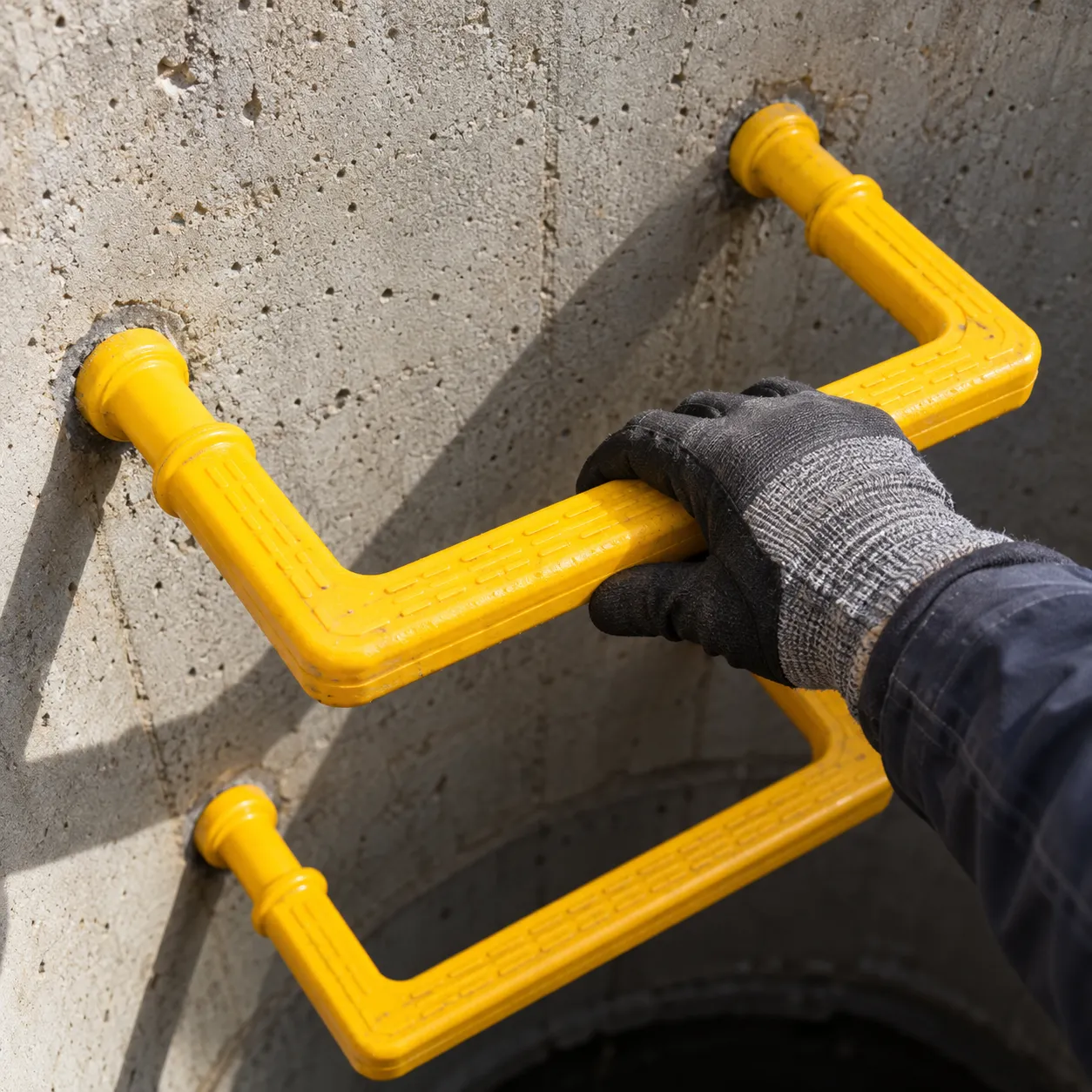
A coated manhole step can look straightforward from the outside. That does not tell you what is carrying the load, what polymer covers it, or how the ends are meant to sit in the wall. Those details vary by model, so a product photo is a poor substitute for a drawing.
For a useful review, match the model number to a section drawing, material information and installation details. Then check the tread, fixing geometry and any test record against that same model. If the resin has not been verified as polypropylene (PP), treat “polypropylene-coated” as a question to resolve, not a fact to assume.
What are the main parts of a coated manhole step?
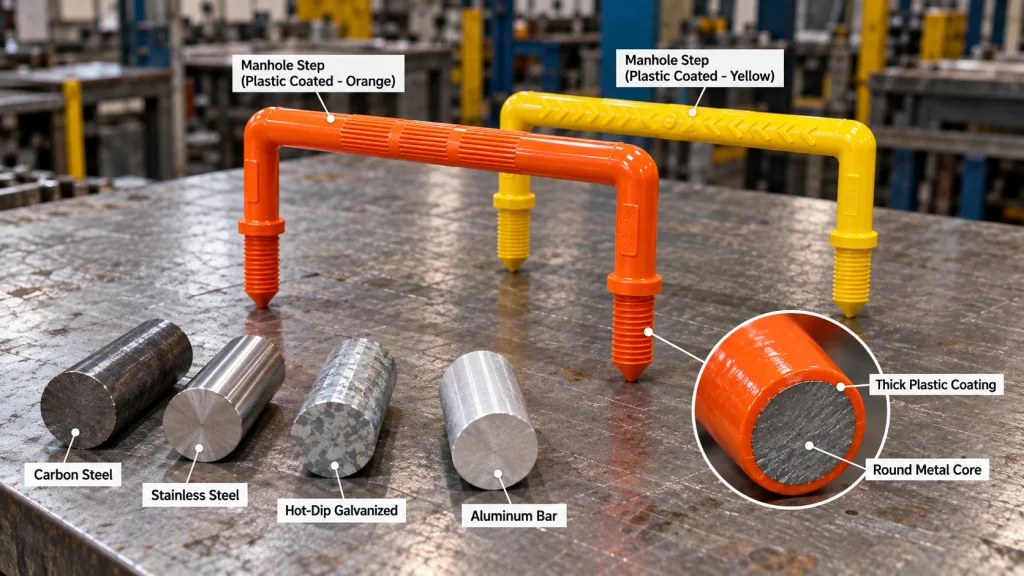
A coated manhole step may combine a load-carrying core, a polymer outer layer, a shaped tread and fixing ends. The exact materials and geometry depend on the model; confirm each item on its drawing and supporting documents.
The core
The core is the part that gives the step its structural form. For a particular SKU, ask what it is made from and check its grade, diameter or cross-section on the drawing. Also confirm whether the core runs continuously through the step or has another construction. A cutaway photo can help explain the design, but the drawing and material record should identify what is actually supplied.
Do not borrow a diameter or steel grade from another manufacturer’s catalogue. Even if two steps look alike, their cores may differ.
The polymer outer layer
The outer layer forms the visible surface around the core. The word “plastic” is not a resin specification: polypropylene, polyethylene and other polymers are different materials. Ask for the resin name and grade, the covered areas, the coating thickness and its permitted tolerance. If the supplier cannot provide a material document for the model, the resin is still unconfirmed.
A coating can be part of a product’s protection design, but its presence alone does not prove a service life, chemical compatibility or suitability for every wastewater environment. Those conclusions need evidence that matches the resin, model and intended conditions. To compare this protection system with exposed zinc coatings, see our PP-coated vs galvanized manhole steps comparison.
The tread and fixing ends
The tread is the part a person steps on; its profile and texture are part of the design. The ends determine how the step is fixed or embedded. Check the actual tread dimensions, leg length, spacing, projection and embedment or fixing method. A front-facing photo rarely shows enough to confirm these details.
If you are replacing an existing step, compare the fixing arrangement and wall interface as carefully as the overall width. Similar colour and shape do not establish that two models are interchangeable.
Which core material does the model use?
The model drawing and material record should identify the core material and its size. Check that the SKU, drawing revision and physical sample all refer to the same product before approving it.
Ask the supplier to state the material grade or category, then confirm the core diameter or section on the drawing. If traceability matters for the project, ask what batch or material records can be supplied and how they map to the finished step.
A sample is useful for checking fit and finish, but it cannot reliably identify a hidden alloy or steel grade by sight. If stainless steel or another specific material is required, name the grade in the RFQ and ask for the corresponding document. Do the same for any alternative core option: list it as available only when the supplier confirms that it is an actual option for the model you are buying. Before mass production, check these material details using our manhole step sample qualification guide.
What does the polypropylene coating prove—and what does it not?
A coating description tells you what material is claimed for the outer layer; it does not, by itself, establish thickness, coverage, adhesion, chemical resistance or service life. Ask for evidence tied to the specific model and intended use.
Start by confirming that the resin really is PP. Request the resin grade or supplier declaration, then check whether the coating covers all areas required by the drawing. Ask how thickness is specified and inspected, including the measurement method and acceptance range. If the coating has a test report, check the tested model, method, conditions and result rather than relying on a general statement that the product is “tested.”
There is no safe shortcut from colour to chemistry, or from chemistry to universal performance. PP is a material name, not a blanket approval for every site, fluid or installation. Compare the documented resin and test scope with the project specification.
Why do the tread pattern and fixing geometry matter?
The tread and fixing geometry affect how the step fits the installation and what the project team needs to approve. Confirm them on a dimensioned drawing rather than judging them from a product photograph.
A textured tread may be intended to provide grip, but a visible pattern is not a slip rating. Use a performance claim only when a relevant test supports it and the result applies to the model being considered.
For the fixing ends, check leg length, centre-to-centre spacing, projection, embedment depth and the specified installation method. Confirm that these dimensions suit the wall, precast mould or existing opening. If the project names a standard or owner specification, identify its edition and the clauses that apply to this step; do not assume that a supplier’s general product description settles compliance.
What should you check on a section drawing or datasheet?
Use the drawing and datasheet to connect the model, materials, dimensions and installation method. A complete review lets engineering compare the product with the project requirement before approval.
A practical document check covers:
- Model or SKU and drawing revision.
- Core material or grade, diameter or cross-section.
- Resin name and grade, coating coverage, thickness and tolerance, where documented.
- Overall width, tread dimensions, leg length, spacing, projection, embedment and tolerances.
- Installation method and any limits on the wall, chamber or project type.
- Required material certificates, inspection records or test reports, with the model and scope identified.
For the full enquiry information list, use our manhole steps RFQ checklist.
If a field is missing, ask the supplier to confirm it in writing or mark it as not available. A blank on the datasheet is not evidence that the requirement has been met.
How can quality checks verify the construction?
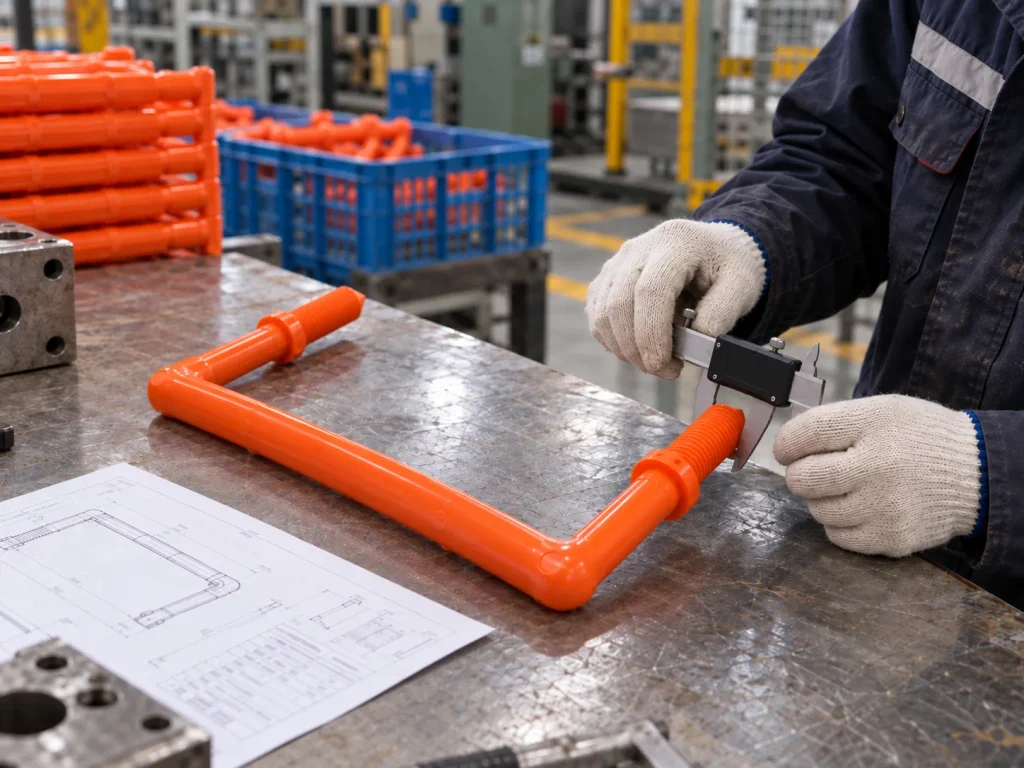
Ask which checks are performed on the selected model and what records can be shared. The useful evidence is specific: an identified part, a defined check and a result that can be traced to the relevant batch or drawing.
Depending on the supplier’s actual process, checks may cover incoming material identification, formed dimensions, coating coverage and appearance, critical dimensions, batch identification and packing. Do not assume every supplier performs every check. Ask which ones apply and whether there is a record.
For a load, pull-out, impact or coating test, confirm the test method, sample identity, conditions, acceptance criterion and report scope. A diagram can explain a proposed test; it is not a test report. Likewise, a report for one model should not be presented as proof for every size or construction.
Preguntas frecuentes
Are all plastic-coated manhole steps made from polypropylene?
No. Confirm the resin from the supplier’s material record for the relevant model. Appearance alone does not distinguish PP from PE or another polymer.
Can I identify the core material from a product photo?
Usually not. Request a section drawing, material record or an identified cutaway sample.
Does every model have the same coating thickness?
Do not assume so. Check the specification and inspection evidence for each SKU.
Will one coated step fit every manhole?
No. Width, fixing ends, wall construction and project requirements can all affect fit.
Which documents should I request before approval?
Start with the model drawing, material information and installation details. Add only the tests or inspection records required by the project, and confirm that each record covers the model under review.
Before approving a model, compare its drawing and material records with the project specification.
If the step needs a revised core or fixing geometry, see FERR’s custom manhole step options.