

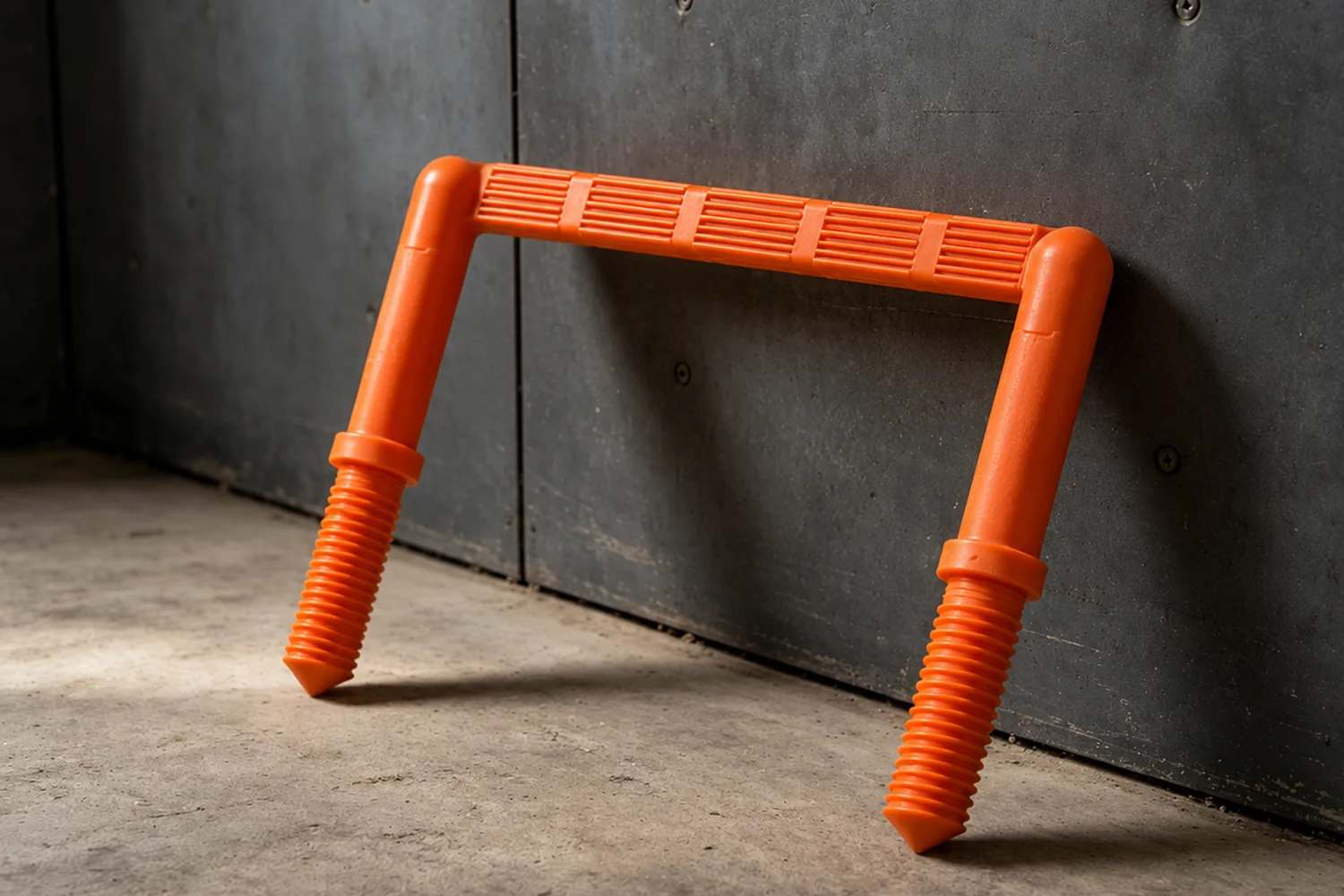
Say three quotes for 5,000 manhole steps land in the same week: $1.18, $1.42 and $1.63 a piece. (These are made-up numbers.) The obvious move is to reply to the cheapest.
Hold off for a minute.
The $1.18 is EXW, so the price stops at the factory gate. The $1.63 is CIF, so it already pays the sea freight to your port. And none of the three says what steel is inside the plastic.
A bulk manhole step quote is only useful when every supplier is pricing the same specification, the same quantity and the same delivery scope. Until then you’re comparing three sets of assumptions.
This guide fixes that in order. Lock the product. Open each quote up line by line. Convert everything to one landed cost at your warehouse. Then check quality evidence and delivery risk before you score anyone. In the worked example, the $1.18 quote doesn’t come out cheapest. And with one realistic complication added, it comes out last.
Make Sure Every Supplier Is Quoting the Same Product
Before you compare a single price, confirm that every supplier quoted the same core, coating, dimensions and compliance evidence. A lower price for a different step isn’t a saving. It’s a price for a different product.
Fix the Material and Core Specification
“PP-coated manhole step” describes the outside. Inside is a steel bar, and that bar carries the load. A thicker bar or a higher grade costs more, so it’s the first place a low quote can quietly differ.
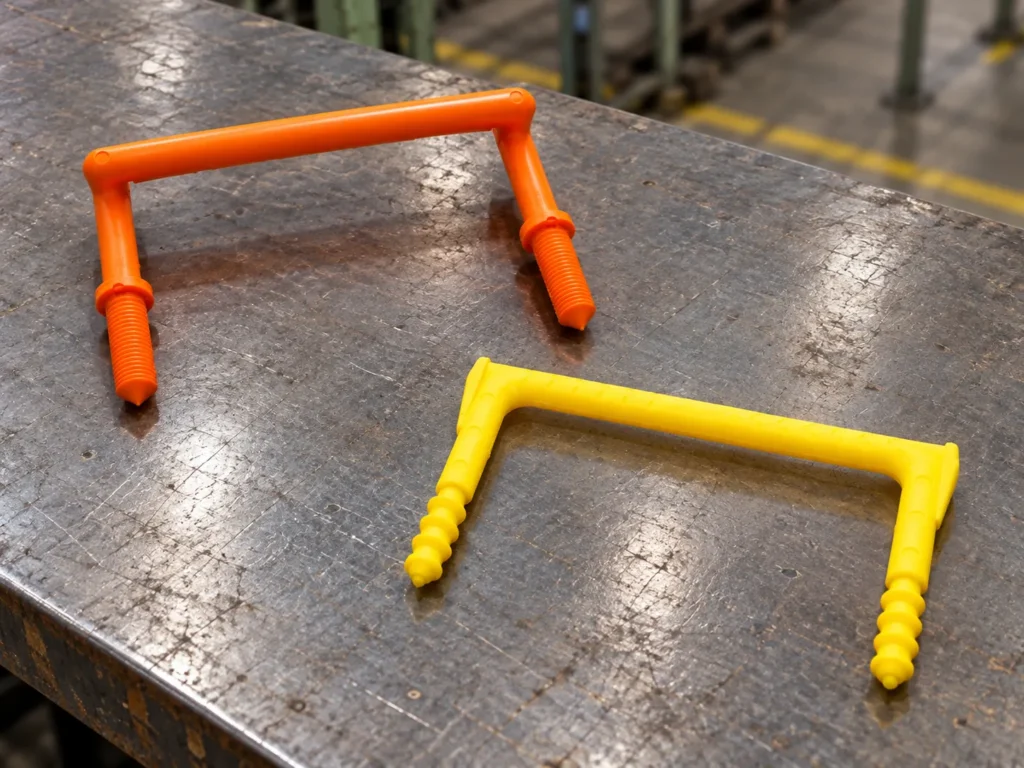
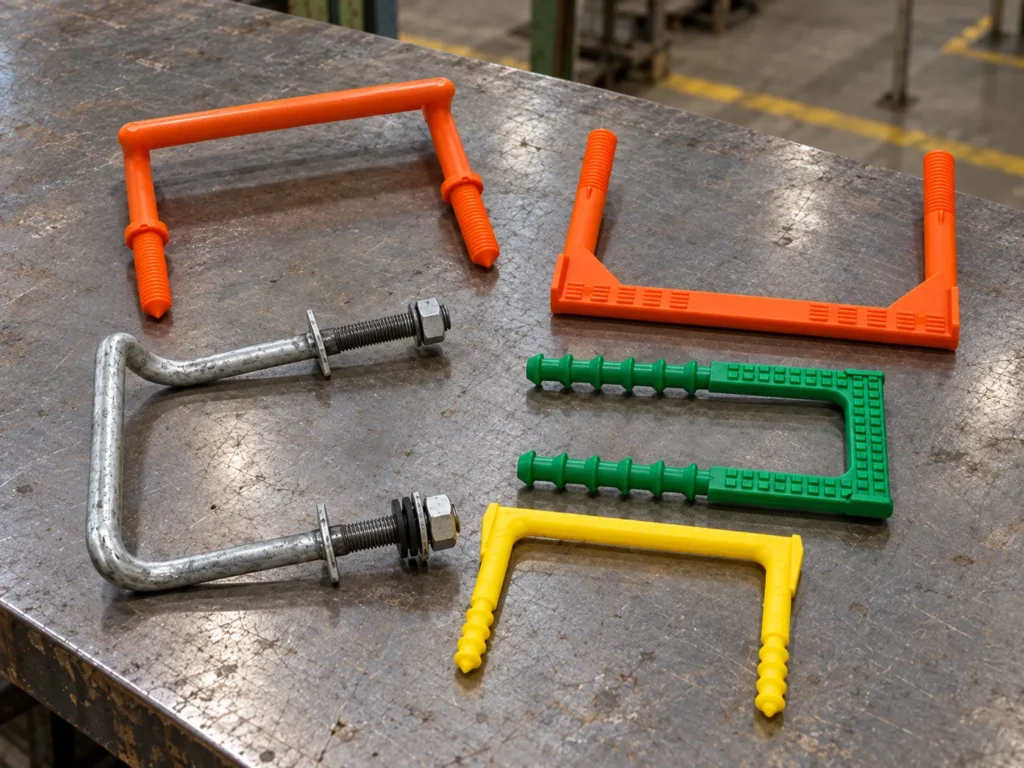
Two suppliers can both write “PP-coated” and mean different bar diameters, different steel grades or a different plastic. PE-encapsulated steps get sold as “plastic-coated” too. Write the full build as one line: core material, grade and diameter, coating resin, colour, plus coating thickness if your spec sets one. Then make every supplier either confirm that line word for word or list where they differ.
Match Dimensions and Installation Geometry
A matching width doesn’t mean the step fits. Fit depends on leg centre distance, leg length or embedment depth, projection from the wall, hole diameter, and whether the wall is flat or curved. Tread width matters too, but it’s rarely why a step won’t go in.
Put the drawing revision on every quote. If supplier A priced rev. B and supplier C priced rev. A, C’s price is for a part you no longer want.
The installation detail belongs to one model. Don’t accept a fixing sheet borrowed from a step that only looks similar. If you’re still deciding which dimensions can move, our custom manhole steps page lists the ones we usually review against an existing mould or wall.
Set Pass/Fail Rules for Compliance
Start from your project specification and the destination market. Write the standard, the edition and the evidence you need as pass/fail rules. A supplier who fails a mandatory clause is out. A low price can’t buy that back, and neither can a high score anywhere else.
One quick check catches a lot. EN 13101 covers the steps themselves. EN 124 covers manhole covers and gratings. If a step quote mentions “D400”, the load class has come from the wrong standard, so ask what was actually tested.
Compare the Full Quote Structure, Not Just Unit Price
The unit price is one line of the quote. Break every quote into the same lines (quantity, currency, payment terms, tooling, samples, testing, packaging) and mark each one included, extra or unknown before you compare anything.
Confirm Quantity Tiers, MOQ and Currency
Start with the basics, because they’re the easiest to miss. Is the price per piece, per carton or per set? (If it’s a set, what’s in it?) Which quantity tier does it apply to? A price for 10,000 isn’t comparable with one for 5,000. Does it include tax? How long is it valid? And if your order drops to 3,000, does the price hold?
If the quotes are in different currencies, convert them all at one rate on one date. Otherwise exchange-rate movement will look like one supplier is cheaper.
Then look at payment terms. A 30% deposit with 70% against the bill of lading is a different deal from 100% up front, even at the same price. The more you pay before shipment, the more of your cash is tied up and the more you lose if something goes wrong. Ask for the weight per piece as well, because section 3 needs it.
Identify Tooling, Sampling and Testing Charges
A custom size, colour or logo usually means a new mould. Ask for tooling as its own line. Also ask who owns the tool once it’s paid for, who maintains it, whether any of the cost is refunded after a set volume, and whether the sample fee is credited against the first order.
Across our custom metal parts, a tooling fee that surprises the end customer is one of the most common reasons a project goes on hold after the first quote. Better to see that number now than after you’ve picked a supplier. (Our drawing review and sampling process shows where tooling decisions come in.)
Testing works the same way. For material certificates, load or pull-out reports, third-party testing and pre-shipment inspection, ask whether each one is included, extra or not offered.
Check Packaging and Replacement Terms
Packaging looks like a detail until freight gets priced by the cubic metre. Steps packed denser cost less per piece to ship. That’s why a supplier’s carton count shows up in your landed cost.
Ask for pieces per carton, carton size, net and gross weight, pallet type, moisture protection and labels. Then ask what happens when steps arrive damaged or out of spec: replaced at the supplier’s cost, credited against the next order, or left to you? Section 3 shows why that answer is worth money.
To see the gaps, give each supplier a column and put a status in every cell, not a tick:
| Quote line | Supplier A | Supplier B | Supplier C |
| Unit price, currency, quantity tier | |||
| Payment terms | |||
| MOQ per SKU | |||
| Tooling cost and ownership | |||
| Samples and sample freight | |||
| Test reports / third-party testing | |||
| Pre-shipment inspection | |||
| Packaging: pcs per carton, carton size, weight | |||
| Replacement terms for damaged or rejected steps | |||
| Incoterm and named place | |||
| Quote validity | |||
| Lead time and its start point |
Use four statuses: Included, Extra ($ amount), Optional y Unknown. Every “Unknown” becomes a question to that supplier before you compare.
A table full of “Unknown” usually means the RFQ was thin. Our manhole steps RFQ checklist covers what to send so suppliers don’t have to guess.
Normalize Incoterms and Calculate Total Landed Cost
Convert every quote to the same destination, quantity and cost boundary, then add whatever each seller left out. Divide that total by the number of pieces you can actually use, and you have the only unit price worth comparing.
Confirm the Exact Incoterm and Named Place
“FOB” on its own is half a term. FOB Qingdao and FOB Shanghai are two different prices, and so are CIF Rotterdam and CIF Hamburg. Ask for Incoterms® 2020 plus a named port or place on every quote.
Then check where each term stops. Under Incoterms® 2020, cost and risk don’t always move to you at the same point:
| Term | Seller pays up to | Risk passes to you | Still on your bill |
| EXW (named place) | Goods ready at seller’s premises | At seller’s premises | Loading, export clearance, all transport, import |
| FCA (named place) | Handover to your carrier, export cleared | At handover | Main freight, insurance, import, delivery |
| FOB (named port) | Goods on board at origin port | On board at origin | Ocean freight, insurance, import, delivery |
| CIF (named port) | Freight plus minimum insurance to destination port | On board at origin | Unloading and port charges, import clearance, duty, delivery |
| DAP (named place) | Delivery to the named place, ready for unloading | At the named place | Unloading, import clearance, duty |
Four things in that table catch buyers out:
- EXW leaves the export declaration to you. That’s awkward to arrange from abroad, so ask who will actually file it and what it costs.
- CIF stops at the destination port. It doesn’t reach your warehouse.
- CIF insurance is a minimum. The rule asks for Institute Cargo Clauses (C) cover at 110% of the contract price. That’s narrower than the “all risks” cover most buyers assume.
- The ICC doesn’t recommend FOB or CIF for containers. If the goods are handed over at a container terminal rather than loaded on board by the seller, the ICC recommends FCA instead of FOB, and CIP instead of CIF. Your steps will almost certainly ship in containers, so it’s worth asking for.
Convert Every Quote to One Destination and Quantity
Use the same two formulas for every supplier:
Normalized total cost = goods value + costs the seller’s term doesn’t cover (export, freight, insurance, import, destination handling) + project costs (tooling, samples, testing)
Normalized unit cost = normalized total cost ÷ pieces you can actually use
Mark every figure as quoted o estimated, and get the estimates from your forwarder and customs broker, not from the supplier. Leave import VAT or GST out if your company reclaims it. Most registered importers do, but check yours.
Show a Worked Example Using Three Hypothetical Quotes
Same spec, 5,000 pieces, a stock design with no tooling, delivered to the same buyer warehouse, in USD. Every figure is invented to show the method. None of them is a FERR price or a real freight or duty benchmark.
| Cost per piece (USD) | A · EXW | B · FOB | C · CIF |
| Quoted price (covers its own term) | 1.18 | 1.42 | 1.63 |
| + Export handling, origin charges | 0.20 | 0.00 | 0.00 |
| + Ocean freight and insurance | 0.22 | 0.20 | 0.00 |
| + Import duty (assumed 5% of CIF value) | 0.08 | 0.08 | 0.08 |
| + Destination port and clearance | 0.07 | 0.07 | 0.07 |
| + Delivery to warehouse | 0.10 | 0.10 | 0.10 |
| + Testing not covered by the quote | 0.05 | 0.00 | 0.04 |
| Normalized cost per piece | 1.90 | 1.87 | 1.92 |
| Total for 5,000 pcs | 9,500 | 9,350 | 9,600 |
A’s $1.18 unit price ends up second. B wins, by three cents a piece.
Look how small the spread has become: five cents a piece, $250 on the whole order. Now add the complication. Suppose A’s batch arrives with 3% of steps out of tolerance, and A’s quote has no replacement clause. You’ve paid $9,500 for 4,850 usable steps, which is $1.96 each. A goes from second to last.
Flip one condition and that result disappears. If A replaces rejects at its own cost, your price per usable step stays at $1.90 and the only loss is time. So a replacement clause is part of the price, not small print.
On duty: it’s charged on the customs value, which depends on the declared price, the tariff code, the origin and the destination country’s rules. The EU values imports on a CIF basis, while the US leaves international freight and insurance out. Have your broker work out the real figure for each quote rather than copying the flat 5% used here.
Want a quote built on your spec and delivery term? Send FERR your drawing, quantity and destination and we’ll quote it line by line, so it drops straight into this table.
Check Quality Documentation and Production Controls
Quality differences don’t show on a quote. Turn them into documents you can check: test reports for your model, material certificates and a written inspection scope. A report for a different model doesn’t count.
Request Model-Specific Test Evidence
Depending on your spec, ask for vertical load, pull-out, impact and coating-integrity results, plus material certificates for the core bar. A report only helps if it names the model, the test method and standard edition, the date and the lab.
No report for your model yet? “Not tested yet, here’s the plan and the cost” is a fair answer. That cost then goes onto the quote as its own line. In the table above, it’s the testing row.
Compare Inspection Scope and Traceability
Two quotes can both say “inspected” and mean very different things. Ask whether inspection happens before mass production, on every batch, on a sampling plan, or only as an old report on a sample.
Then follow the paper trail. Are batch numbers traceable to material lots? What happens to out-of-tolerance parts? If your third-party inspector fails a batch, who pays for the re-inspection? Those answers decide whether a 3% reject rate like the one in the example lands on you or on the supplier. For a repeat-order audit, use our distributor manhole step supplier checklist.
For a comparison point, here’s how FERR inspects and records custom parts.
Account for Lead Time, Capacity and Order Reliability
You can only compare two lead times if you know when each clock starts. Ask for sample, tooling, production, inspection and shipping as separate durations, each from a named start point.
Separate Sample, Tooling and Mass Production Lead Times
“30 days” counted from what? Deposit, drawing approval and sample approval can be weeks apart, so two suppliers both quoting “30 days” may not be promising the same date.
Plan for the whole route, too. Across our custom metal parts, getting from first inquiry to a bulk order usually takes two to three months or more. Nearly every buyer tests samples first, and some samples go round twice. A schedule for a newly tooled step that skips the sample stage needs a good explanation. For questions about order thresholds and timing commitments, see our manhole step MOQ and lead time guide.
Confirm Capacity, Batch Split and Change Control
Ask for capacity for your SKU, not the factory’s headline output. Can they split deliveries to match your pour schedule? Will the orange in batch three match batch one? If you change the drawing after approval, what happens to the dates already agreed? And will you hear about a delay when it happens, or only when you chase?
A late container never shows up on the quote, but it still costs you: an idle mould, a delayed site, a customer on the phone. That’s why delivery gets real weight in the next section.
Use a Fair, Weighted Supplier Comparison Matrix
Run the gate first and score second. Any supplier that fails a mandatory technical requirement is out before price is scored. Everyone else gets scored only on evidence they’ve actually sent.
Apply Mandatory Technical Gates First
Mark each supplier Pass, Fail or Pending on every mandatory requirement from section 1. Pending is not a pass. It’s an unanswered question, and that supplier stays out of scoring until it’s answered. For the broader technical review, see how to choose a manhole step manufacturer.
Score Only Technically Acceptable Suppliers
| Criterion | Example weight | Evidence to score from |
| Technical compliance | Gate (must pass) | Drawing, spec, approved sample |
| Normalized purchase cost | 30% | Section 3 calculation, same destination and quantity |
| Quality records and testing | 25% | Model-specific reports, inspection scope, traceability |
| Lead time and capacity | 20% | Written schedule with start points, capacity for your SKU |
| Installation fit and OEM support | 15% | Fit check, tooling plan, number of open deviations |
| Commercial transparency | 10% | Payment, validity, cost boundaries, replacement and change terms |
These weights are our suggestion, not an industry standard. If you’re re-ordering a step that’s already proven in your mould, shift weight from quality toward cost and delivery.
The gate and the fit row measure different things. The gate asks whether the step meets the spec at all. The fit row asks how well it’s been shown to work: a sample test-fitted in your mould scores higher than a drawing that matches on paper.
Score each criterion from 1 to 5. For cost, the lowest normalized cost gets a 5 and every other supplier gets 5 × (lowest ÷ theirs), so the 3-cent gap in our example works out to a fraction of a point, not a 5-versus-1. Write down the evidence behind every score and the initials of whoever checked it. That last column sounds like bureaucracy, but it’s what stops “we can provide all reports” from scoring a 5.
Watch for Hidden Costs and Quote Red Flags
Most hidden costs come from what a quote leaves out, not from anything it says. Check for these gaps before you trust a total.
Spot Incomplete or Unverifiable Quotes
7 quote red flags
- “PP manhole step” with no core grade or bar diameter
- “EN certified” with no report, edition or model number
- A load class like D400 (that’s from EN 124, for covers)
- An Incoterm with no named place, like “FOB China”
- No MOQ, or a lead time with no start point
- “Standard packing” with no carton count or weight
- No validity date, or a raw-material surcharge clause with no formula behind it
One of these might just be a busy sales rep. Three in one quote means it isn’t ready to compare.
Clarify Exceptions Before Approving a Purchase Order
Send each supplier a short technical and commercial clarification sheet. For each open point, record the quote version, who answered and the date. Any deviation still open is no included by default, however the phone call went.
This matters most when you use one quote as a target price for another. Send the clarified line items with the number. A target price with no scope behind it just starts the guessing again.
Still deciding which factories to ask? Start with how to choose a manhole step manufacturer.
Request a Comparable Bulk Quote from FERR
A fair comparison starts with an identical RFQ: the same package, the same deadline and the same breakdown request for every supplier, FERR included.
Send the Same RFQ Package to Every Supplier
That package covers the model or drawing with its revision, core and coating requirements, the required standard and test evidence, quantity and order schedule, packaging, destination, and the Incoterm with a named place. If you don’t know something, write “unknown”. Don’t leave it blank.
Ask for a Clear Breakdown
Ask each supplier to mark every line Included, Excluded or Optional, and to list anything they couldn’t confirm. Quotes in that format drop straight into the tables above.
Comparing bulk manhole step quotes right now? Send FERR your drawing, quantity and delivery term. We’ll quote the same lines you’re asking everyone else for and list anything we still need to confirm. Then judge us with the same table.
Preguntas frecuentes
Why do manhole step quotes vary so much?
Usually because suppliers aren’t quoting the same thing. One assumed a thinner core bar, one included third-party testing, one priced EXW and another CIF, and one built tooling into the unit price while another listed it separately. Fix the specification, ask everyone for the same itemised lines, then compare. Much of the gap usually comes from those differences, not from one factory being far cheaper.
Should I compare EXW, FOB or CIF unit prices directly?
No. Each term stops at a different point: EXW at the factory, FOB on board at the origin port, CIF at the destination port. Before comparing, convert every quote to the same named delivery point, usually your warehouse. Add the freight, insurance, import and handling costs each seller didn’t cover, using estimates from your forwarder rather than the supplier.
What is a fair MOQ for bulk manhole steps?
There’s no universal number. MOQ depends on whether the step is a stock design or needs new tooling, the material, the factory’s setup costs and how often you’ll re-order. Don’t judge the MOQ alone. Ask for a price ladder, say at 1,000, 5,000 and 10,000 pieces, so you can see how setup cost spreads across volume.
Does the cheapest manhole step supplier offer the best value?
Not necessarily. Once quotes are normalized to the same delivery point, the gap can shrink to a few cents a piece. A small reject rate with no replacement clause, a failed test or a late container can wipe out that saving. Score price alongside quality evidence and delivery, and only for suppliers who pass your technical requirements.
What documents should suppliers include in a bulk quotation?
At minimum: the specification or drawing revision quoted, material details for the core and coating, the test or quality evidence for your model, packaging details, the lead time and its start point, payment terms, quote validity, and the Incoterm with a named place. Also ask for a list of deviations and anything they couldn’t confirm.