

Most industrial and general fabrication relies on three main welding machines: SMAW (stick), MIG, and TIG. This guide explains the differences to help you choose the best welder for your needs.
Each machine operates differently, yielding varying weld quality and suitability for materials and job requirements. Understanding their heat input, appearance, speed, cost, and skill needed helps you select the right machine for your workshop or project supplier.
Stick welders are simple and forgiving. MIG welders offer speed and versatility. TIG welders provide precision and a high-quality finish. Selecting the right machine leads to these outcomes:
Wrong Machine Selection:
– Poor weld strength
– Excessive spatter
– Distortion
– Rework during assembly
Right Machine Selection:
– Stable joints
– Predictable quality
– Lower overall cost

SMAW Welding Machines
Arc welding power source
Stick welding uses a constant-current (CC) power source, meaning the current remains steady during welding while the voltage can vary. In a constant-voltage (CV) power source, the voltage remains constant while the current can vary. The electrode melts to form the weld, and the flux coating creates shielding gas as it burns.
Modern SMAW machines, such as the inverter-type ZX7 series, are compact, energy-efficient, easy to start, and widely used in small workshops and for field repairs. Brands such as Lincoln Electric and Miller make reliable SMAW machines for a range of welding needs.
Welding materials
SMAW is suitable for carbon steel, low-alloy steels, some stainless steels, and cast iron. Electrode coatings and cores exhibit different levels of penetration, arc stability, and mechanical properties.
Welding workload and applicable scenarios
Stick welding tolerates dirty, rusty, or outdoor conditions with less impact from wind, humidity, or dust than MIG or TIG, making SMAW suitable for:
- Construction sites
- Pipe repair
- Outdoor maintenance
- Heavy structural welding
The trade-off is rougher welds and the need to remove slag after each pass.
Advantages
- Equipment is affordable. Entry SMAW machines range from $100 to $300, advancing up to $1,000, fitting various budgets.
- Works in outdoor and harsh environments
- Good penetration and strong joints on thick materials
- Portable for on-site use
Common application areas
Shipbuilding repair, pipeline maintenance, chassis repair, structural steel fabrication, and general field service operations.

MIG Welding Machines
Requirements for the Degree of Welding Automation
MIG uses a continuous wire feed and a shielding gas (usually CO₂ or argon-mix). Because the wire feed is automated, welding speed and consistency are higher than with SMAW. For example, an operator switching from SMAW to MIG reports a 30% reduction in cycle time, showing improved efficiency and the simplicity of the automated process. In SMAW, typically 20 minutes per foot of weld can be expected, while MIG reduces this to about 14 minutes per foot. This contrast highlights the benefits of using MIG over SMAW in suitable applications.
MIG welding is generally more accessible for new operators due to lower coordination requirements than SMAW or TIG.
Welding Materials and Process Requirements
Used for carbon steel, stainless steel, and aluminum (with proper wire and gas).
To ensure high-quality MIG welds, specific environmental conditions must be met. Here is a checklist for MIG welding readiness:
– Ensure the surface is clean.
– Maintain a stable gas flow.
– Perform welding indoors or in a sheltered area to avoid wind.
MIG welding is not suitable for outdoor, windy environments unless properly sheltered, as unstable gas flow and dirty surfaces can impair weld quality.
Differences between gasless MIG welding and conventional MIG welding
Gasless MIG uses flux-cored wire to generate shielding gas, enabling outdoor use but increasing spatter and reducing smoothness. Traditional MIG, requiring stable shielding gas, offers cleaner, stronger, and more stable welds. Weigh gasless MIG’s portability against about 20% more spatter.
MIG welding costs include wire ($2–$5/lb) and shielding gas ($30–$50 per cylinder refill). Flux-cored wire costs $3–$7/lb but eliminates gas expense.
Advantages
- High welding speed
- Easy to learn for beginners
- Cleaner welds with less post-processing
- Stable and repeatable weld quality
- Suitable for thin sheets
Common application areas
Automotive parts, metal furniture, sheet-metal fabrication, stainless-steel products, and medium-scale production environments.
SMAW and GMAW address distinct applications. For thick materials, outdoor use, or suboptimal surfaces, select SMAW for its adaptability and weld strength. For thin materials or when prioritizing aesthetics and productivity, use MIG (GMAW) to achieve efficiency and a refined finish.
Neither method is universally better—each addresses specific challenges. Use SMAW when working with thick materials, outdoors, or on less-clean surfaces, as it excels in adaptability and strong welds. Opt for MIG (GMAW) for thin materials, aesthetically pleasing results, and higher productivity, since it offers cleaner, more efficient welds under controlled conditions.
TIG Welding Machines
Welding materials
TIG handles almost all weldable metals, including stainless steel, aluminum, copper alloys, and titanium, as well as thin-wall precision parts.
Welding precision requirements
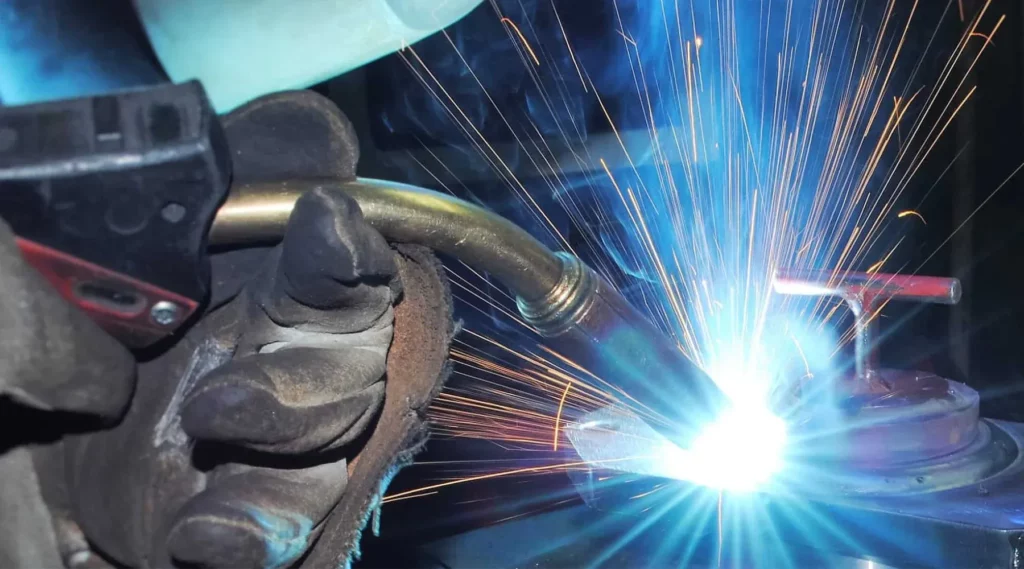
TIG provides the highest arc control and precision. Heat input is controlled by pedal or fingertip, producing clean, spatter-free welds. TIG makes sanitary stainless welds that pass rigorous borescope inspections—ideal where flawless, high-quality welds are vital.
This is why TIG is chosen for high-end fabrication and visually critical parts.
Welding Current Range and Control
Use AC mode for aluminum and magnesium, DC mode for steels. TIG demands steady power and skill, especially when working with thin materials, to avoid warping. Confirm workshop compatibility: most TIG machines run on 110V or 220V, but higher-capacity models may require special wiring.
Advantages
- Best weld appearance
- Highest precision
- Minimal spatter and rework
- Ideal for thin, expensive, or heat-sensitive metals
Common application areas
Food-processing gear, pressure vessels, aerospace parts, high-end stainless products, bicycle frames, medical equipment, and precise assemblies.

FAQ
Is SMAW TIG or MIG?
SMAW is neither.
- SMAW = Stick welding (electrode-based, flux-shielded)
- MIG = Gas-shielded, continuous wire feed
- TIG = Tungsten electrode with separate filler rod
Each uses different principles for different jobs.
What are 1G, 2G, 3 G, 4G, 5G, and 6G welding?
These refer to welding positions:
- 1G: flat position
- 2G: horizontal
- 3G: vertical
- 4G: overhead
- 5G & 6G: pipe welding positions—6G being the most challenging (pipe angled at 45°)
Positions matter because weld difficulty, heat control, and defect risk change with orientation.